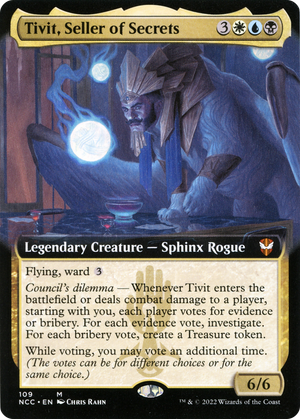
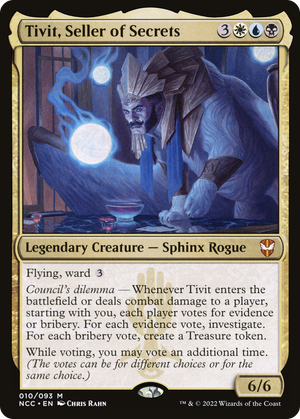
Tivit, Seller of Secrets




Voting cards had always leaned on the fiction that other players might sabotage your outcome; Tivit dispenses with that fiction entirely. The additional-vote clause folds neatly into council's dilemma to guarantee that the person controlling the Sphinx wins every referendum, because you vote first, you vote twice, and every outcome is a reward: evidence votes hand you Clues to sacrifice for cards, bribery votes hand you Treasure to spend on more. There is no downside branch to the dilemma, which is the whole trick. Most council's dilemma designs distribute a good thing and a bad thing so opponents' votes actually matter; here both options are goods, so your two-vote head start snowballs the count in your direction no matter how the table votes. That turns a six-mana 6/6 flyer into a resource engine that fires on entry and again on every connection, and the ward tax exists precisely to protect the loop from cheap removal long enough for it to matter. The design also quietly rewards blinking or reanimating the body: each re-entry is another full vote, another pile of Clues and Treasure. It is the rare political creature that is not political at all, a machine built to look like a negotiation while conducting a one-sided auction where every bid is yours.
Rules text
Council's dilemma — Whenever Tivit enters or deals combat damage to a player, starting with you, each player votes for evidence or bribery. For each evidence vote, investigate. For each bribery vote, create a Treasure token.
While voting, you may vote an additional time. (The votes can be for different choices or for the same choice.)