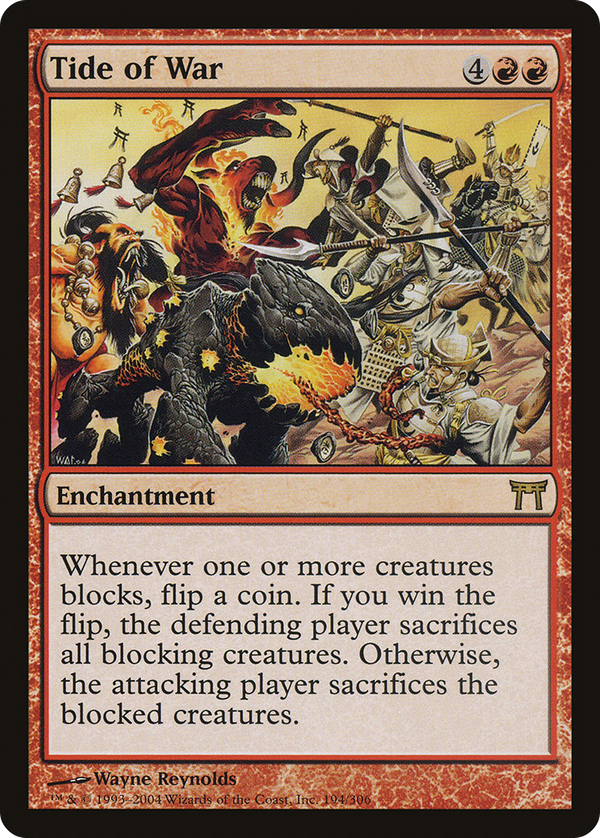
Tide of War


The coin flip is the joke and the trap. Combat math, the most deterministic subsystem in the game, gets handed over to a fifty-fifty: declare blocks, then watch half the board fall to chance. The design is a deliberate inversion of how blocking is supposed to work. Normally the blocker chooses whether to trade; here, the act of blocking at all puts every committed creature on the line, attacker and defender alike, with the outcome decided after the decision is locked. That makes it a tax on combat itself rather than a tool either side controls, which is why it reads as a chaos enchantment more than a board-control piece. The symmetry cuts in whichever direction the flip lands, so it punishes the player who needs combat to resolve cleanly more than the one happy to let bodies pile up in the graveyard. An aggressor swinging into open mana and a defender holding a wall both have to weigh whether they want the coin involved at all, and the answer is usually no, which is the design's real function: it freezes attacks from both directions out of mutual unwillingness to gamble. Cards built this way belong to a small lineage of variance-as-mechanic enchantments, the ones that turn a normally skill-driven phase into a wager. They survive at the table on novelty and the willingness to embrace the swing, never on reliability.