Thunderscape Apprentice

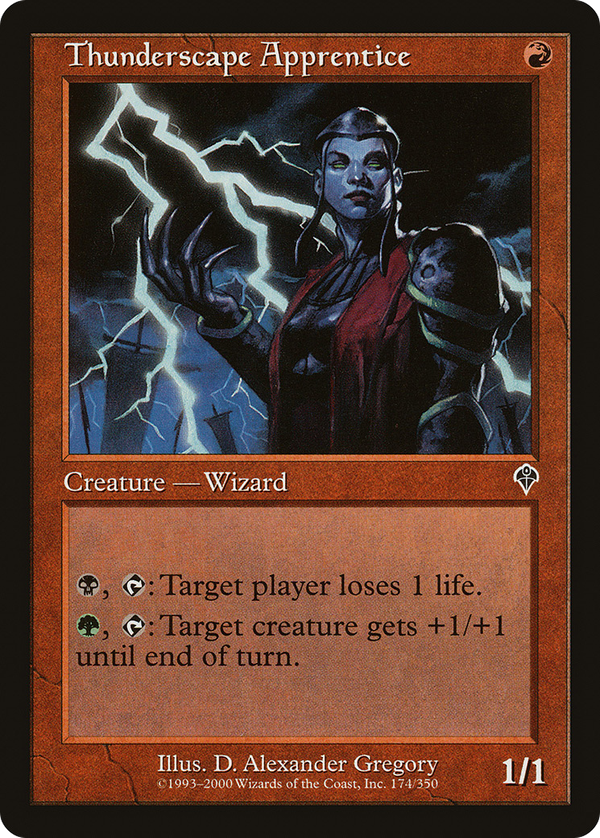
The cost structure is the design statement: a red one-drop whose two tap abilities both demand mana red cannot produce on its own. Pay black and it drops a player one life; pay green and it pumps a creature. Neither mode fires unless your manabase reaches into the other two colors, which makes this Wizard less a card than a credential, proof that you assembled a real three-color base rather than a splash. The tap symbol gates it further: even with all the right mana untapped, it sits inert the turn it lands, since it has no haste and each activation costs the creature's only tap. So it typically does just one job per turn, unless you can untap it. The black mode is the more durable one, a slow trickle of inevitability that asks only that the game go long; the green pump turns it into a marginal combat aid, the kind of thing that nudges a trade in your favor rather than swinging a board. None of this adds up to a high-impact card, and it was never built to be one: this is a creature whose whole function is to reward a deck that has already committed to red-black-green, nibbling at the edges while the cards around it carry the game. The construction is honest about its modest ambitions, an early-era experiment in pricing a creature's relevance against the difficulty of its own activation.
Rules text
 ,
,  : Target player loses 1 life.
 , : Target creature gets +1/+1 until end of turn.