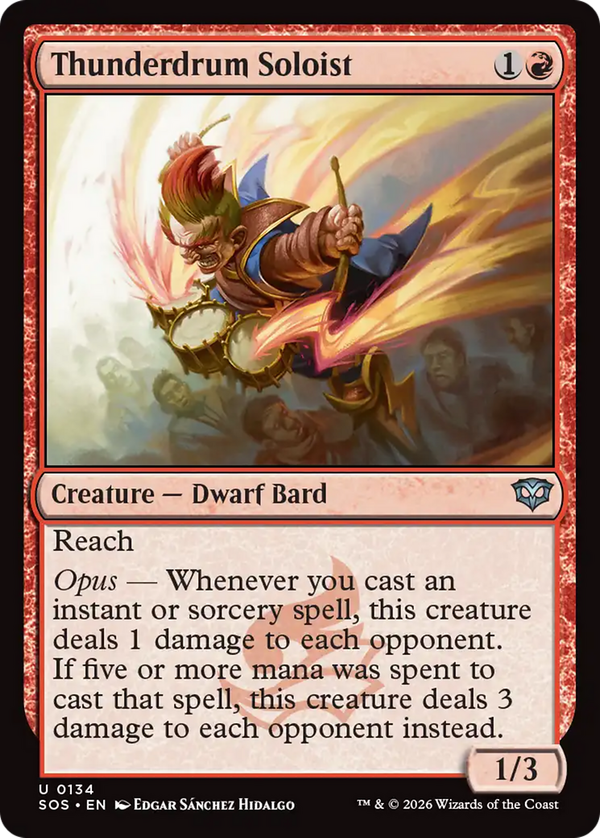
Thunderdrum Soloist


Opus solves a specific problem for spell-matters payoffs: how do you reward a deck for casting expensive spells without gating the whole engine behind them? A tiered trigger fires on every instant or sorcery for one damage, then jumps to three when the spell cost five or more mana to cast. That structure means the card is never dead in a shell full of one- and two-mana cantrips, but it pays out disproportionately for the big X-spells and clunky finishers a spellslinger deck already wants to run. The damage hits each opponent rather than any target, which quietly reframes the creature: it is not a removal engine or a tempo tool but a passive clock, converting spell velocity into a steady drain while your instants and sorceries do the heavy lifting elsewhere. Reach on a 1/3 body is the defensive complement, letting it hold the ground against flyers a spell-heavy deck tends to struggle with while it pings away in the background. This is a considered attempt to give burn-adjacent decks a way to close on life totals without pointing every spell at a face, and the five-mana breakpoint is the lever that keeps the two damage tiers meaningfully distinct: it draws a hard line between the cheap spells that keep the engine ticking and the expensive ones that reward committing to it, rather than smearing the payoff across a flat curve.