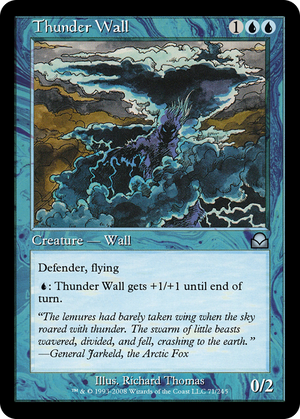
Thunder Wall


A flying wall is a tidy bit of early-blue economy: it covers the ground and the air at once, doing the work of two creatures in a single defensive slot. The repeatable pump is the part that gives the card its texture, turning mana you would otherwise leave open for counterspells into incremental toughness so the wall survives bigger attackers each turn, and it scales: against a board that has grown out of single-block range, you can sink mana to hold the line rather than chump and lose the body. The thing the pump does not do is convert defense into offense. Defender forbids attacking outright, and no amount of evasion or alpha-strike rider changes that; without a specific effect that lets defenders attack, every point of pumped power only ever matters on the block. That is the honest read on the design: the activated ability looks like an offensive lever but is structurally a blocking tool, a way to keep one creature relevant across many combats instead of one. It is a product of an era that handed blue creatures activated abilities by default and trusted players to find the windows; the rate is unremarkable by later standards, but the structure (a flier that can grow without ever swinging) is a neat snapshot of how the color's early defensive toolkit was assembled, before the game settled on cleaner lines between attackers and the things that stop them.
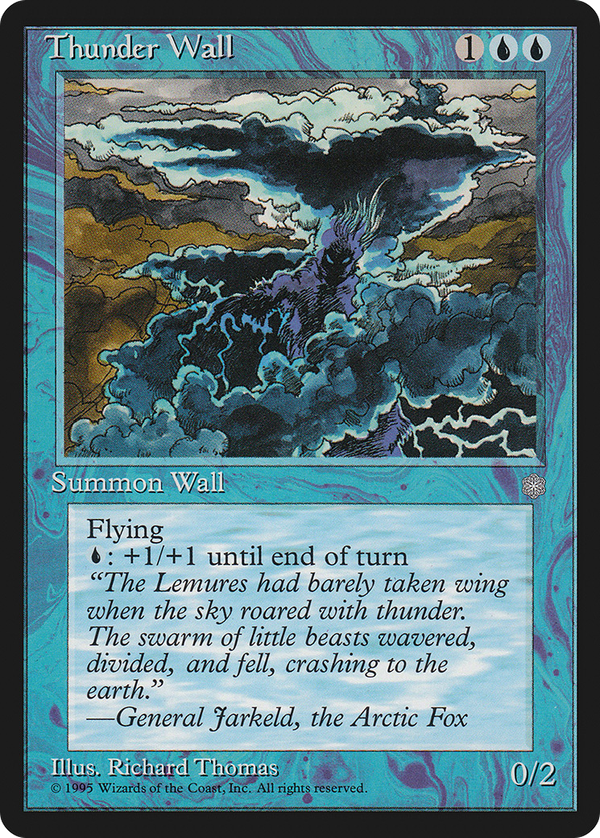
Rules text
: This creature gets +1/+1 until end of turn.