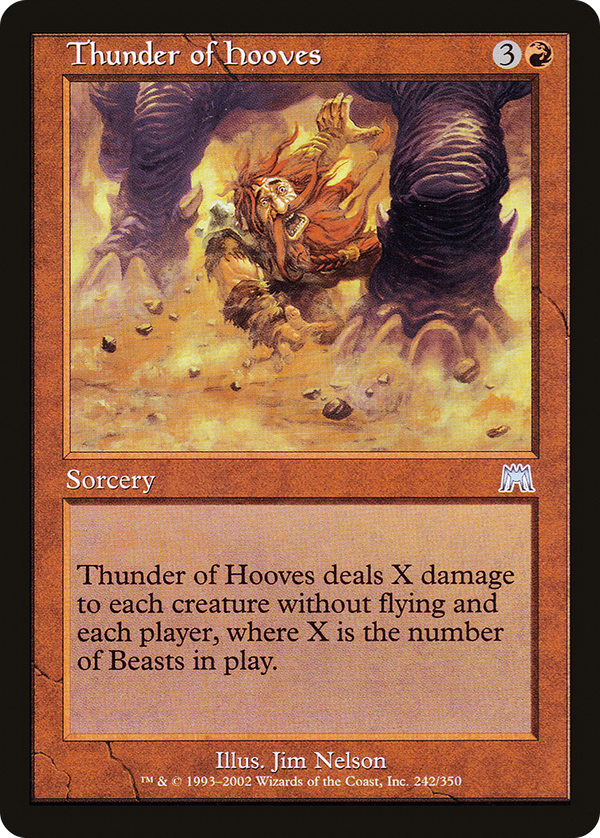
Thunder of Hooves


The damage doesn't scale off how much you've invested; it scales off how many Beasts are in play, yours and theirs alike, which makes this a sorcery whose power is borrowed from the whole board rather than your own. The tension is timing: cast it early and X is too small to matter, but wait for a critical mass of bodies and the symmetry threatens to torch your own army on the way out. Two clauses pull it back from being a plain board wipe. The flying exemption lets a deck keep evasive threats overhead while the ground burns, so a stalled position can become a one-sided sweep rather than a mutual one. And the damage to each player turns a board you cannot profitably attack with into reach: an opponent stabilized at a low total takes the same X to the face that their grounded creatures take, which converts a clogged stalemate into a four-mana kill. The structural catch is the one that kept it a curiosity: a card that counts Beasts wants a tribal shell, but a tribal shell wants its Beasts alive, and pointing this at your own swarm is only worth it when your fliers and your opponent's life total carry the math. It rewards a board state that most aggressive red decks of its day simply never assembled, which is why it lived as a tribal payoff rather than a generalist answer.