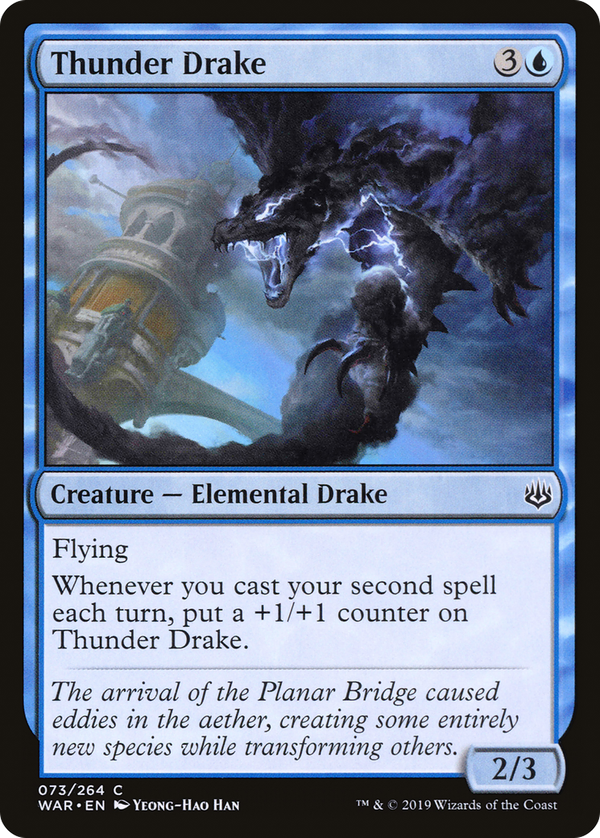
Thunder Drake


The reward tucked into the second-spell trigger pays you for a play pattern you were already trying to build: a low curve, cheap interaction, and enough card flow to reliably fire twice in a turn. That constraint is the whole cost of the ability. A single fat spell does nothing; two small ones stack a counter and grow this evasive body one point at a time, so the card asks for a deck sequenced around volume rather than mass. The 2/3 flier threatens little until the engine gets going, and it demands you deploy spells in pairs rather than dumping your hand all at once. The real payoff is how it turns spell-count into a persistent, non-token clock: unlike a prowess creature that swells for one turn and reverts, each counter here is permanent, so a Drake that survives a few turns of double-spelling becomes a genuine finisher instead of a fleeting threat. This is the slower, more durable branch of spell-matters design, one that asks a deck to prove its tempo across multiple turns rather than spike a single one. The cap of one counter per turn keeps the growth honest and steady rather than explosive, a deliberate throttle on a creature that could otherwise snowball out of a storm-adjacent shell.