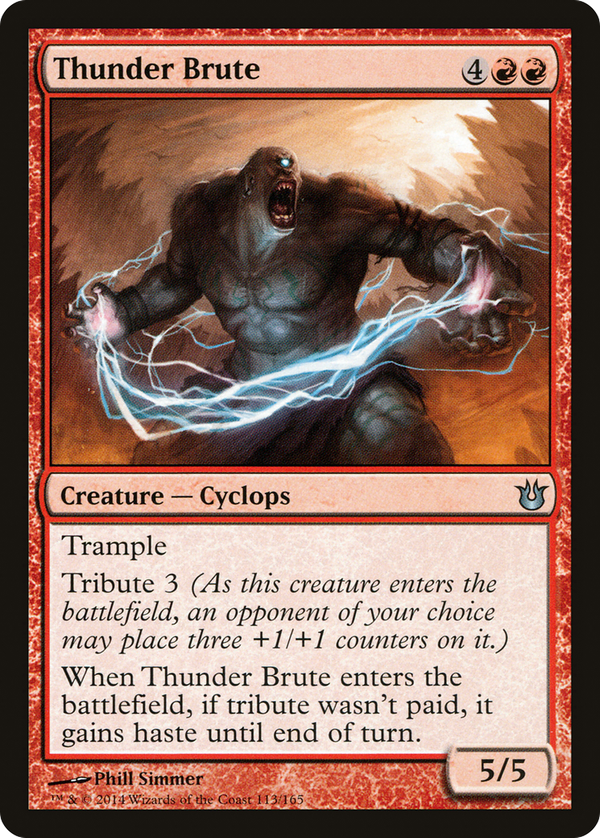
Thunder Brute


Both branches of this Cyclops favor the attacker, and the opponent's only job is to choose the least painful one. Feed the counters and an 8/8 trampler stands across the table; starve them and a 5/5 trampler with haste attacks the turn it resolves, the rider covering the sluggishness that usually dogs a six-mana beater. Which is worse depends entirely on the life totals and blockers in front of you: against an open board the hasty mode often steals a race outright, while three extra power stapled to a trampler mostly stalls. That is the real trick of the keyword here. Evaluation gets shoved onto the player least equipped to run the math, and under pressure at that: your opponent has to read your hand, your sequencing, and the state of the race, then commit before your next play reveals which branch you actually wanted. The stat line, flat on paper, becomes a small information game the controller is set up to win. The haste clause is the sharpest piece of it: without that rider, declining the counters would be a free out, and the design would collapse into "give them the smaller creature." Instead, refusing tribute buys the attacker tempo rather than nothing, so both answers carry a cost and neither offers relief.