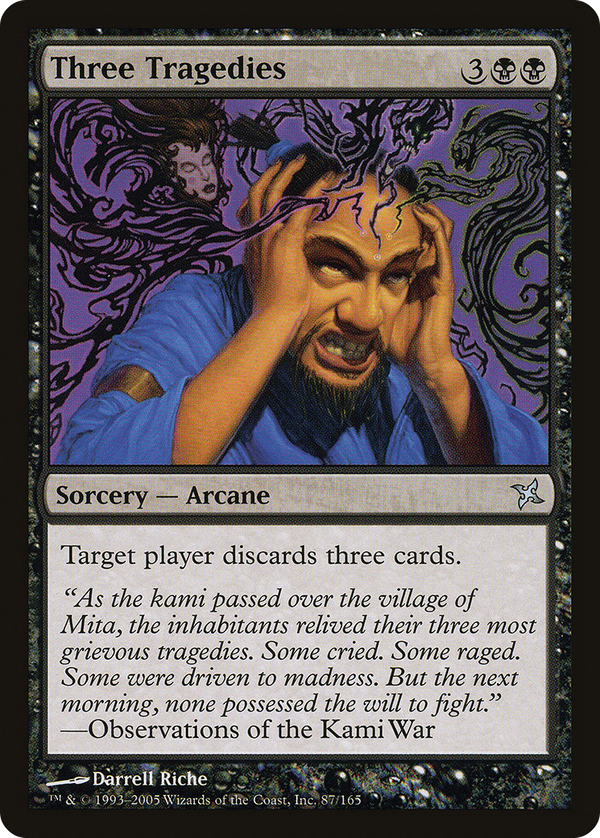
Three Tragedies


Stripping three cards from a single hand for five mana is a steep rate, and on the raw exchange this design rarely justifies its double-black cost: a one-sided hand attack that arrives well past the turns discard is best deployed against, when an opponent is still committing the openings you most want to disrupt. The going premium for that much forced discard was already understood by the time this printed, so the card-advantage math was never the selling point. What gives it any distinction is the Arcane subtype. As an Arcane spell it can be a splice host: other spells with splice onto Arcane can be tacked onto it without paying full freight, folding the discard into a larger packaged cast. That hook is what kept a slow, expensive hand-rip relevant to the spirit-and-Arcane builds of its era, where having Arcane on the stack mattered for reasons beyond stripping a hand, long after a vanilla discard sorcery of the same cost would have been forgotten. Note that it carries no splice ability of its own: it cannot ride another spell, only serve as the spell others ride. Pulled out of that ecosystem, it is a hand attack the rate alone never earned; inside it, the discard is a rider the deck collects almost incidentally.