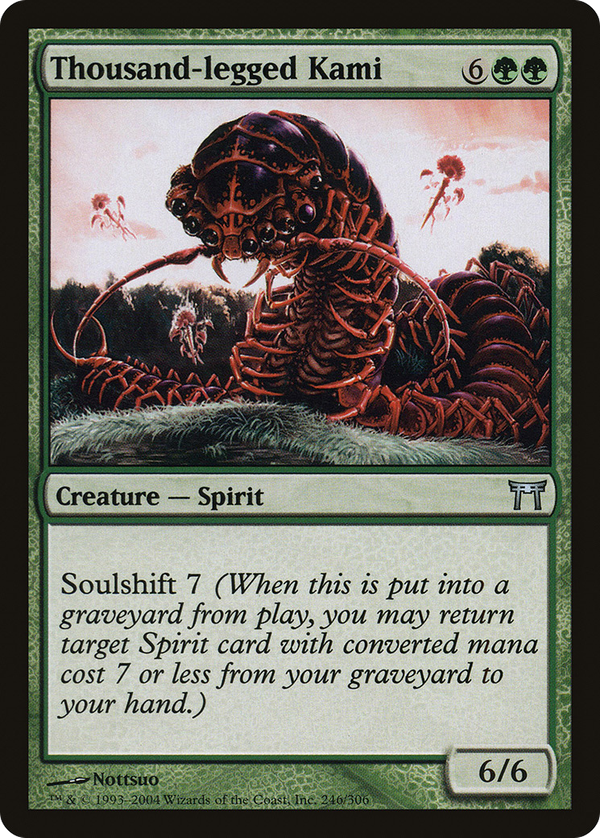
Thousand-legged Kami


Soulshift's design problem is that a death-trigger only matters as much as what it can drag back, and most of the cycle could only reach the cheapest Spirits low on the curve. This one pushes its recursion number as high as the mechanic ever scaled, which makes it the terminal node of the whole soulshift web: when it dies, it can return almost any Spirit a Kamigawa deck would actually want back, including the expensive ones that anchor a late game. That breadth is expensive twice over. The eight-mana investment is enormous, and the payoff is gated behind a creature dying rather than entering, so you need both a graveyard worth raising and a board willing to trade into one. The 6/6 body is incidental; the real offer is a Spirit chain that climbs back up the curve instead of grinding along its floor. Reaching its best pieces is exactly what the rest of the mechanic could not do on its own, and that ceiling is what keeps soulshift from reading as a consolation prize. It is the upper bound the cycle was built around, the piece that turns a string of small recursion triggers into a deliberate, interlocking engine.