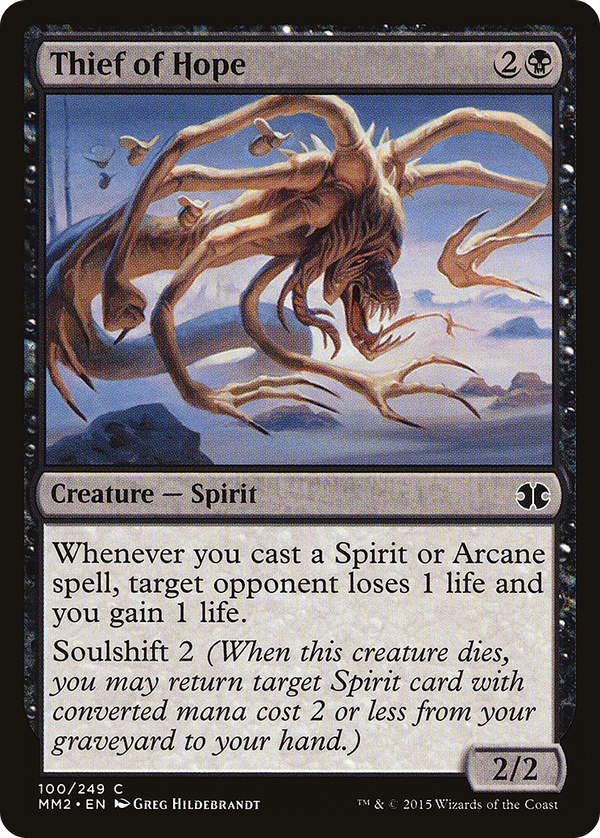
Thief of Hope


The drain trigger keys on a build no other color asks for: a critical mass of ghostly spellcraft, fired off until the opponent's life total leaks away in increments. That is the central tension of this kind of design, where the payoff is tiny per instance and only meaningful when the deck is dense enough to chain triggers across a turn. What matters is the announcement, not resolution: the moment a qualifying spell hits the stack, the life swing is banked, so even a countered spell still drains, and a hand emptied across one turn drains in a steady drumbeat regardless of what survives. The body asks nothing of combat; it sits back and skims a life off the opponent per cast, turning a tempo-neutral creature into a slow clock and a sustain engine in the same slot. Soulshift 2 closes the loop on the back end: when it dies, it can pull a cheap Spirit back from the graveyard, so the card refuses to leave the table empty-handed and rewards a graveyard stocked with the low-cost Spirits the engine wants anyway. It is a tribal-aristocrats piece built before that phrase existed, draining incidentally rather than through sacrifice, and the whole design only functions inside the dedicated shell the mechanic was built around. Strip that context away and the triggers sit idle; inside the shell, this is the reason the deck wins games it never attacks in.