The Wedding of River Song


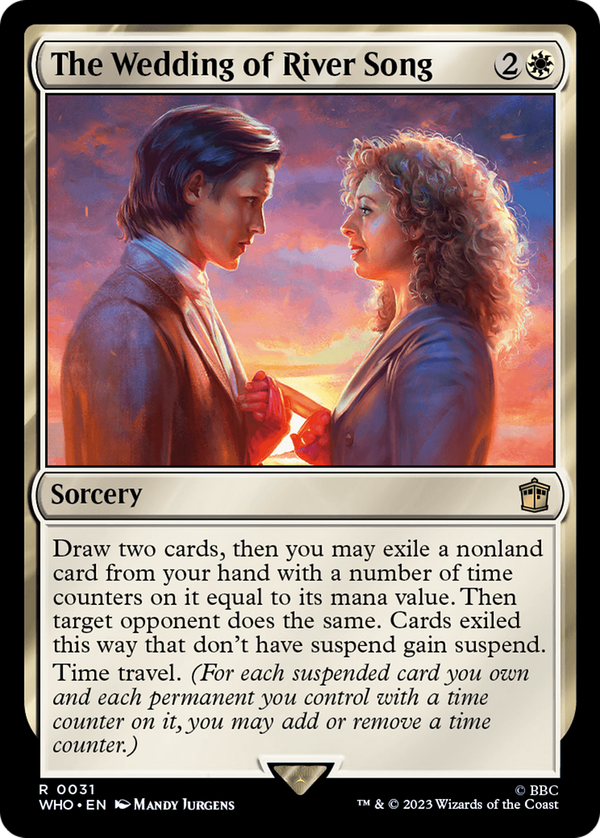
Symmetry is the whole trick here, and it is dressed up as a card-advantage spell to hide the fact that the loading half is the point. The draw two is the sweetener; what the card actually cares about is exiling a nonland from each hand, arming it with time counters that count down from its own converted cost, then handing both cards suspend if they lack it. That is a deferred cast on a fixed clock: each exiled card returns on a turn you can count to in advance. Time counters on suspended cards had always been passive, set at cast and waited out. Time Travel rewrites that, letting you push or pull counters on any suspended card you own, which converts a fixed clock into one you can reset as this resolves. Crucially, the manipulation is one-sided: you can accelerate or delay your own suspended threat, but the card your opponent exiled ticks on its own schedule, outside your reach. So the engine has two asymmetries buried under a symmetric shell. Both players may dig and may arm a threat on a timer, but only you control when yours fires. The advantage is not in the raw cards, then, but in choosing what to exile and owning the clock on your half of the exchange. It rewards a build that already wants spells and creatures arriving on a schedule, and it punishes a pilot who reads the second clause as free selection rather than a mutual arming of two guns, one of which answers only to the other player.