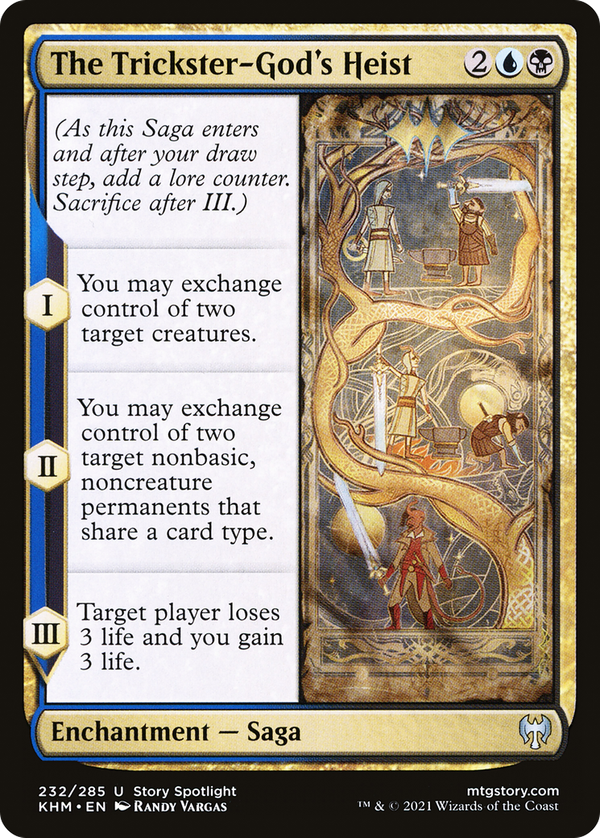
The Trickster-God's Heist



Theft on a timer, structured as a three-act escalation that gets more brazen as the counters tick up. The first two chapters trade rather than take: you exchange control of two creatures, then of two nonbasic noncreature permanents sharing a card type. Crucially, these exchanges are permanent. An "exchange control" effect with no stated duration does not revert when the Saga sacrifices itself, so what you swap away, you swap away for good. That asymmetry is what turns each chapter into a negotiation you get to dictate: because you are giving something back rather than simply stealing, the play is to hand over your worst and pocket their best, or to unload a permanent you no longer need for one that suddenly matters more. Both chapters read "you may," so the Heist never strands you when there is nothing worth trading, the right release valve for a card that advances on its own schedule and cannot be held for the ideal window. The second chapter is the fiddly one: it wants two artifacts, two enchantments, or two planeswalkers in play across both battlefields, and it rewards a build that guarantees that condition rather than praying for it. Then chapter three abandons the fiction of a fair trade and just drains three life, capping the arc with a swing that asks nothing of the opposing board. A trickster fantasy rendered as a control-exchange engine: a shell game you run for three turns, keep the winnings from, and then cash out on the way out the door.