The Tale of Tamiyo


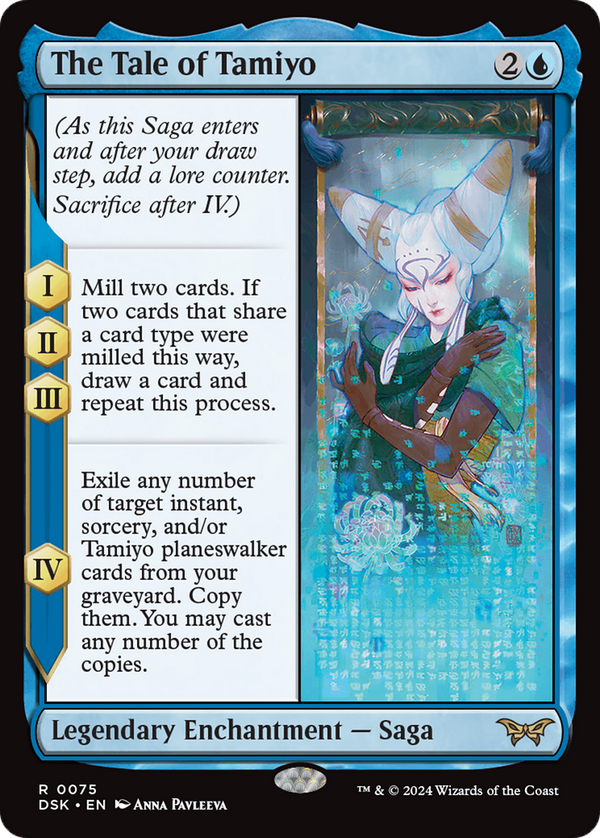
The self-priming mill Saga: chapters I through III don't just mill two cards, they check whether the pair shares a type and recur when it does, turning a fixed effect into a chain whose length depends on your deck's typal density. That's the design lever that pays for the payoff. A graveyard stocked with instants and sorceries wants to hit two spells in a row; a mix of unrelated types stalls out fast. So the card's ceiling is a deckbuilding decision, not a coin flip: you're rewarded for compressing your card types before you ever draw it. Chapter IV cashes the enterprise, exiling and copying any number of instants, sorceries, and Tamiyo planeswalkers you've buried, then giving you permission to cast the copies. Note what keeps this from being a generic reanimation engine: it only reaches spells (and one specific planeswalker's card face), so it rewards a graveyard built deliberately rather than one filled with creatures. And note the cost. Casting those copies is not free; each one still demands its mana, so the payoff is a burst of extra spells you can afford in a single window, not a mana-cheat blowout. The mill on I through III is doing double duty, filling that graveyard while advancing the Saga toward the turn it empties out. It reads as a value engine and plays as a two-part combo: the front half loads the yard, the back half unloads it, and a well-tuned spell suite can stack several castable copies before the Saga sacrifices itself.