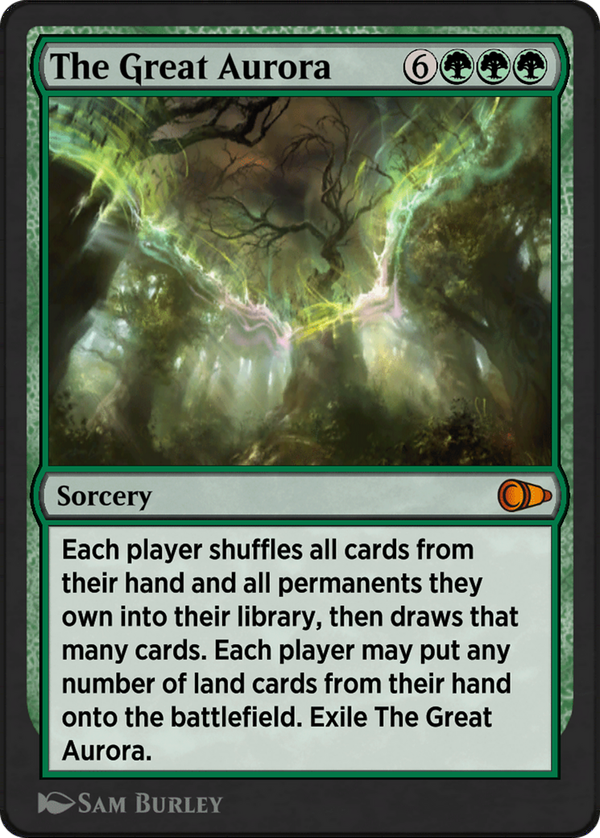
The Great Aurora


The reset button taken to its logical extreme, but read the clause carefully: it does not erase the game. Graveyards, exile, and anything on the stack stay put. What goes back into libraries is what is live and visible: every hand and every permanent, shuffled away and redrawn one-for-one. The genius and the danger share a single line. Each player draws cards equal to what they just buried, hand and permanents both, so whoever has committed the most total cardboard to the table (a wide board plus a stocked grip) rebuilds the deepest new hand. That asymmetry is the whole strategic axis. This is not a symmetrical wipe that bails out the player who is behind; it is a payoff for the player who already overcommitted. The land rider is what keeps the reload from stranding you on empty mana: after drawing, each player may put any number of land cards from hand straight onto the battlefield, so a green ramp deck reassembles its mana base in the same motion it reassembles its threats. It is green's "bigger is better" doctrine stated as a finisher, a spell that asks you to sprawl across the board and then converts that sprawl into raw grip. The price is what stops it from ever rescuing the loser: nine mana, three of it green, for a sorcery that does nothing until you already have a game worth recycling.