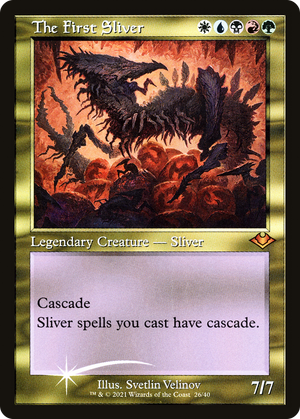
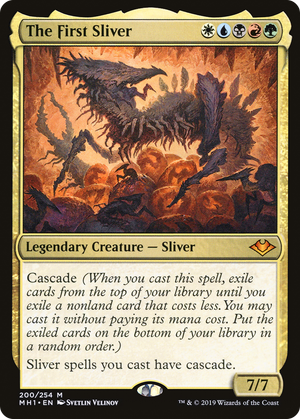
The First Sliver





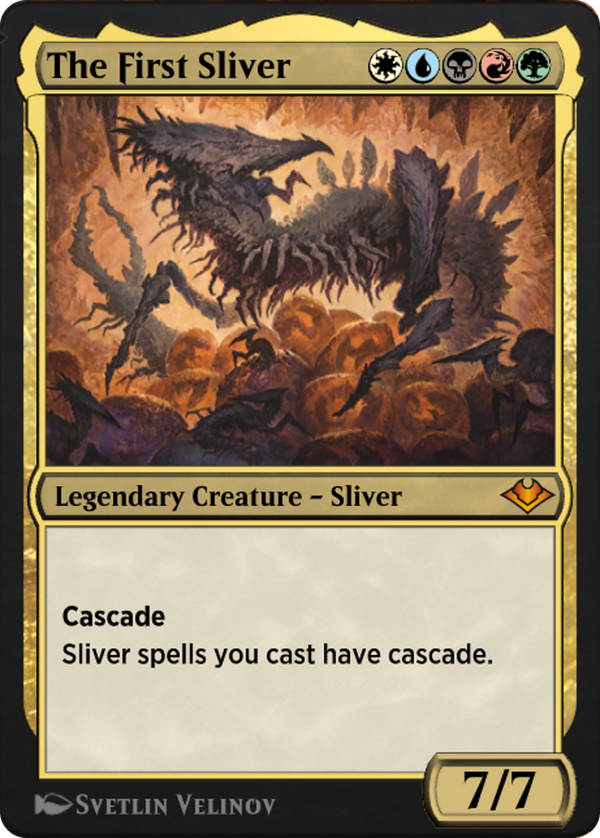
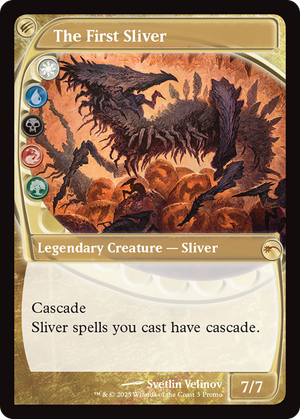
Slivers had always been about the group: the horizontal broadcast, every keyword shared by every body on both sides of the table. This one is the exception, the Sliver that plays vertically. Cascade rewards raw casting rather than accumulation, and the static ability grafts that trigger onto every Sliver spell you cast, so the deck stops caring how wide it gets and starts caring how much value each cast chains into. The strategic axis shifts entirely: a tribe that historically won by out-anthem-ing you now wins by burying you in free spells, each cheaper Sliver dragging another off the top of the library. The five-color identity is the honest tax here. Casting a rainbow legend and then reliably chaining Sliver cascades demands a manabase the tribe's own lords never asked for. There is a real tension between the payoff (turning the whole deck into a cascade engine) and the cost of assembling the colors to reach it. The wrinkle worth flagging is what the engine does not do for itself: the cascade-granting ability is static, so it only functions while this creature is on the battlefield. Cascade from its own cast trigger fires while it sits on the stack, meaning a Sliver you flip into that way arrives without cascade of its own. The chain only compounds once the body has resolved and every subsequent Sliver spell inherits the trigger. That is why it reads less like a tribal lord than a combo piece wearing Sliver clothing: the payoff is not the 7/7, it is the cascade tax it levies on everything you cast afterward.