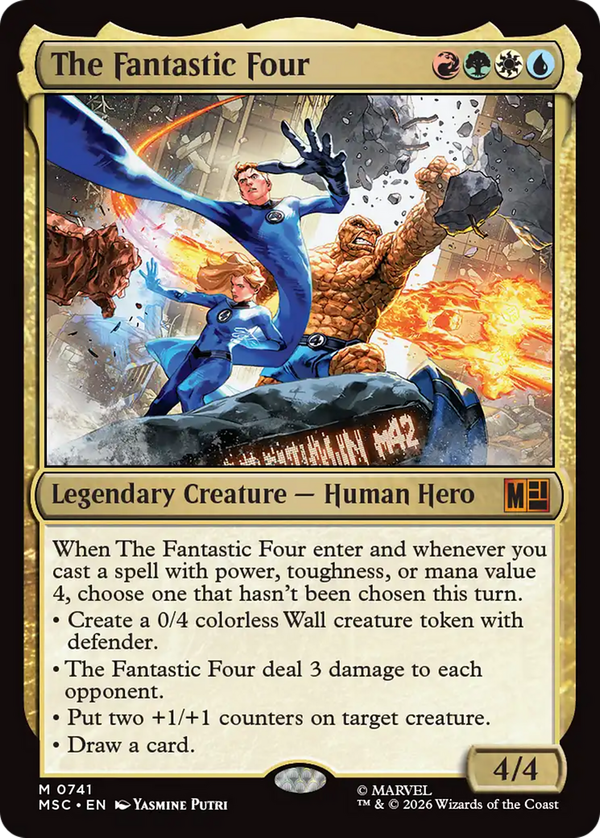
The Fantastic Four




The number four is the entire conceit, and the design commits to it with unusual literalness: not just a four-color identity and a 4/4 body, but a payoff keyed to the number itself, checked across power, toughness, or mana value. That triple reading is what opens the build-around so wide. A spell whose mana value is four qualifies. A creature with power four or toughness four qualifies, regardless of what it costs. The deckbuilding job becomes a hunt for the number four wherever it hides, and each qualifying cast fires the same uniform trigger: choose one mode that hasn't been chosen this turn. The four modes map onto the team's fiction cleanly enough (a defensive Wall, a burst of damage to each opponent, a growth effect, a card), but the no-repeats restriction is where the strategy actually lives. Because your strongest node cannot fire twice in a turn, a burst of qualifying spells inside a single turn cashes out at a steep discount: the first cast grabs the best mode, and the second and third are forced onto weaker options you would not have chosen freely. So the card quietly rewards patience over explosiveness. Spread your fours across turns and each one reaches for the same top mode again; pack them together and you are working down the menu whether you like it or not. It is a commander that asks you to count, then asks you to decide how greedy that counting should be.