The Deck of Many Things

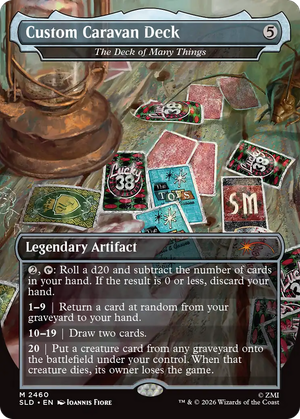
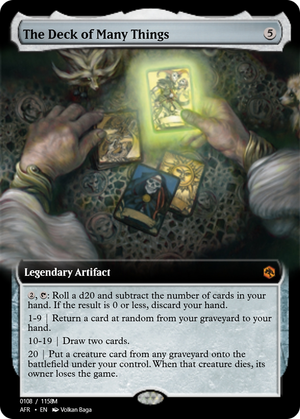
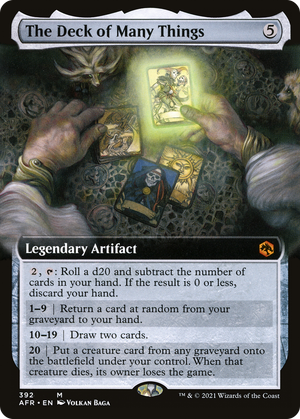
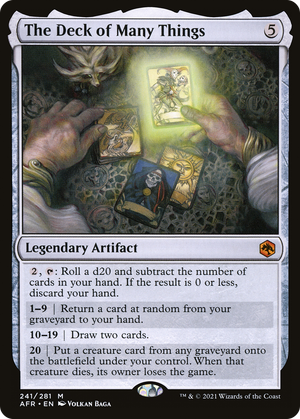
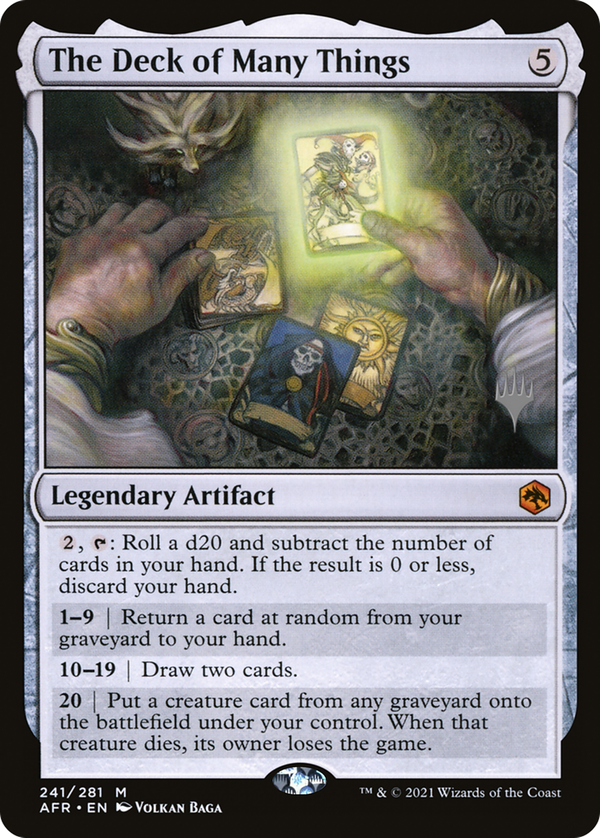
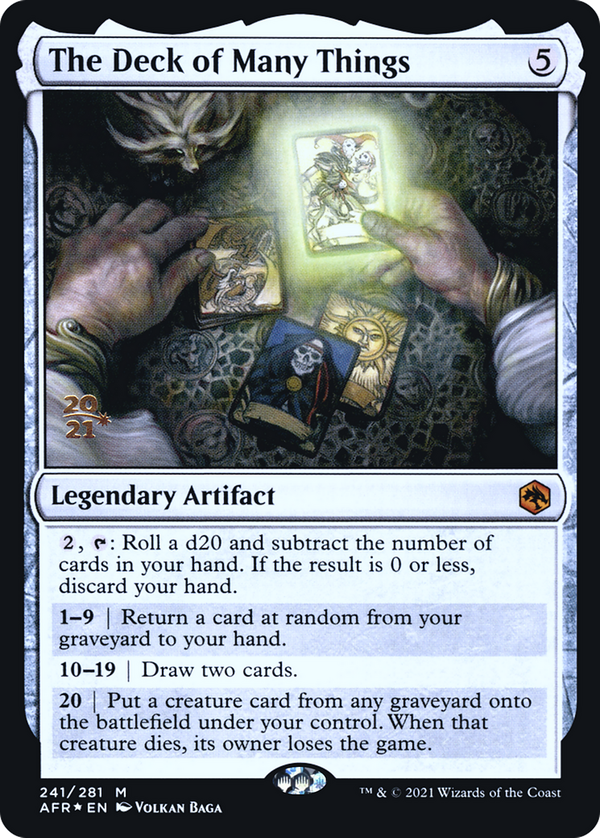
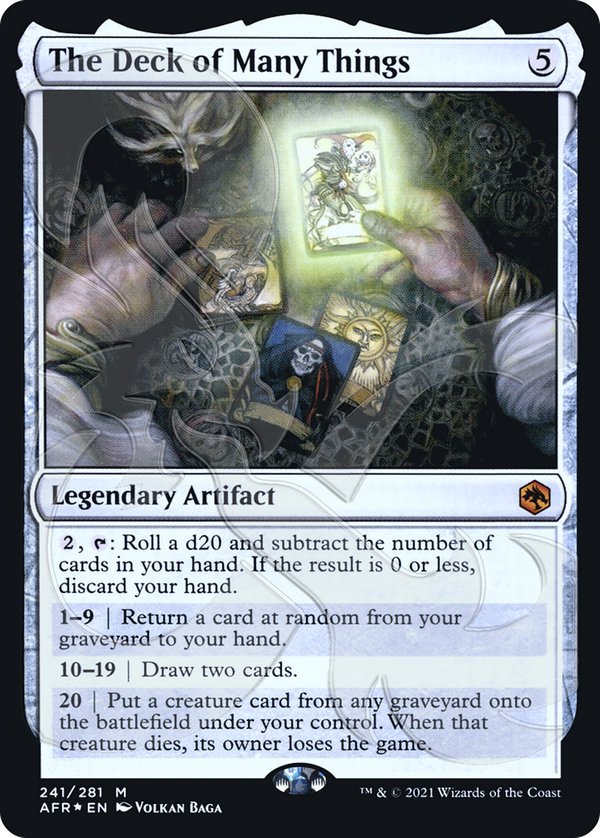
Roll-a-d20 tabletop chaos rendered into a repeatable engine, and the clever part is how the risk scales with your own greed. The subtraction clause turns your hand size into a self-imposed penalty: the more cards you hold, the likelier the roll craters and dumps your entire hand. That single line does the balancing work, keeping a repeatable value machine honest by punishing you exactly when you have the most to lose, so the card wants an empty grip and a full graveyard rather than the fat hand most card-advantage engines reward. The three tiers read as an escalating dream of what a randomizer can be: a floor that rebuys from the yard, a middle band that just draws, and a top result of 20 that steals a creature from any graveyard and staples a death-loses-the-game clause onto it. That top result is the card's real teeth, because the reanimation target need not be yours; the best 20 is often the opponent's own finisher pointed back at them, with the game-ending trigger discouraging them from trading it away in combat. The whole thing is a variance faucet you tap deliberately, best in decks that thin their hands quickly and can absorb the occasional wipe. It is one of the more faithful translations of a tabletop artifact into a functional Magic card: the flavor of drawing from a cursed deck survives intact, and the mechanics genuinely make each activation a gamble rather than a formality.
Rules text
 ,
,  : Roll a d20 and subtract the number of cards in your hand. If the result is 0 or less, discard your hand.
1—9 | Return a card at random from your graveyard to your hand.
10—19 | Draw two cards.
20 | Put a creature card from any graveyard onto the battlefield under your control. When that creature dies, its owner loses the game.
: Roll a d20 and subtract the number of cards in your hand. If the result is 0 or less, discard your hand.
1—9 | Return a card at random from your graveyard to your hand.
10—19 | Draw two cards.
20 | Put a creature card from any graveyard onto the battlefield under your control. When that creature dies, its owner loses the game.