The Death of Gwen Stacy


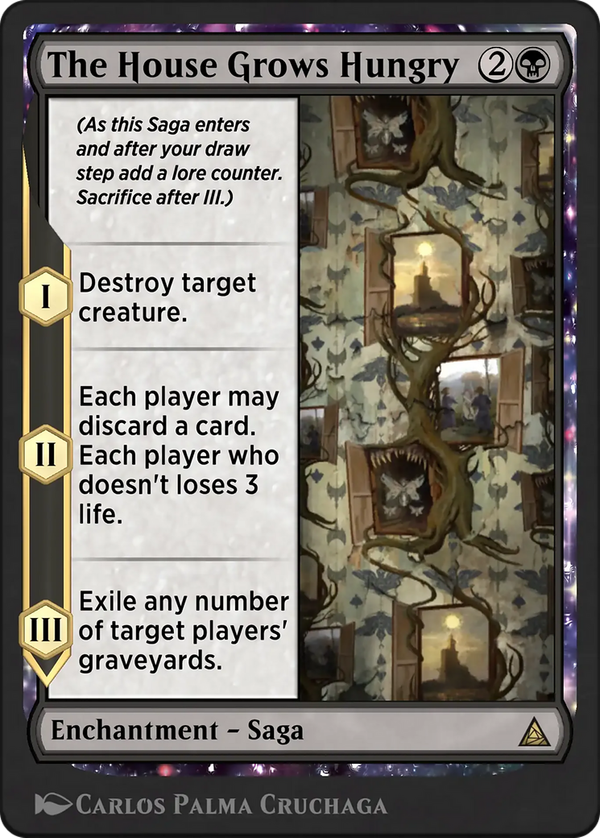
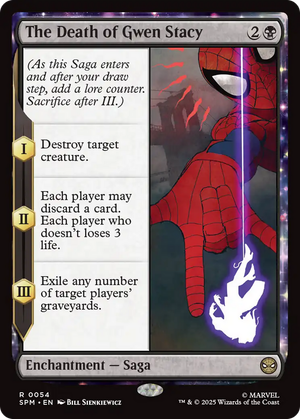
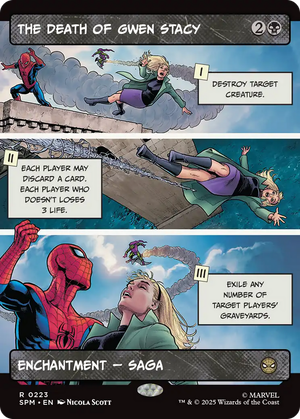
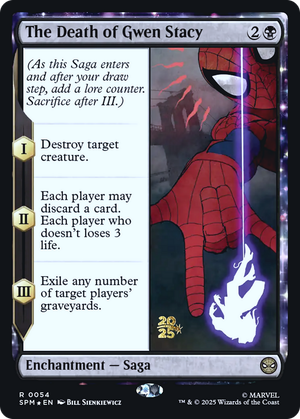
Grief has three beats, and so does a Saga, which is the whole reason this design lands: a single tragic moment gets partitioned into three escalating obligations rather than one big spell. What separates it from most black Sagas is the direction of that escalation. The usual template front-loads the best chapter and lets the rest coast; here the effect widens in scope with each tick, from a single unconditional kill, to a hand-and-life squeeze that hits every player, to a sweeping graveyard exile that closes the sequence by erasing what remains. Because it targets any number of players' graveyards, that final chapter functions as recursion hate against flashback, escape, and reanimation piles, and the lore counters announce it two turns in advance: this is a clock the table can read, and the tension is watching an opponent try to empty their yard before the reach arrives. The middle chapter is the subtler piece. It reads as symmetrical (each player faces the same choice), but the "may discard" clause converts it into a tax rather than a drain: a player with a card to spare walks away untouched, while empty or overcommitted hands pay three life. That optionality keeps the chapter from collapsing into a wash where both sides bleed equally. It is a clean demonstration of how the Saga frame turns narrative sequence into a sequence of decisions, each counter a page you cannot skip.