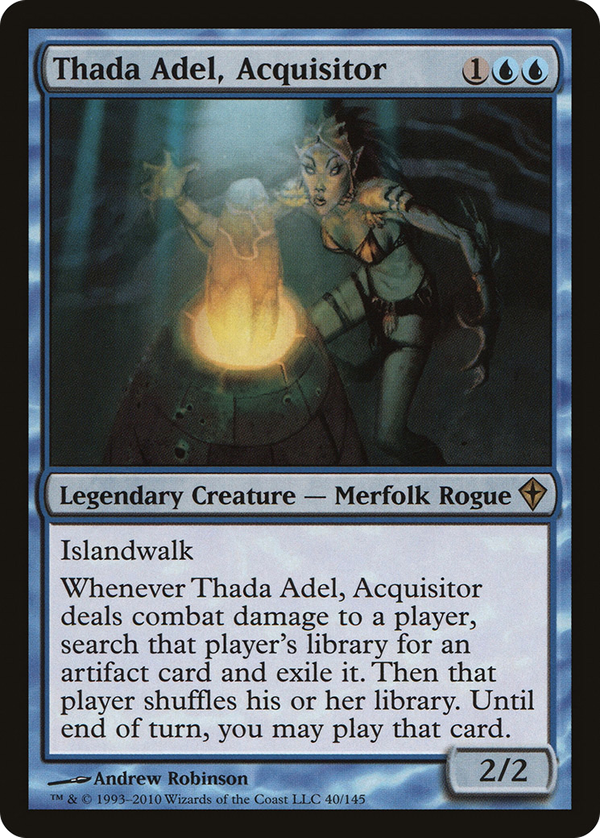
Thada Adel, Acquisitor


Theft cards usually have to bargain for their value with high costs or random outcomes; this one bills the opponent's own decklist as the price tag. The islandwalk is not decoration, it is the delivery mechanism: against any deck holding an Island the body is functionally unblockable, which turns the combat-damage trigger from a hope into a clock. Each connection rifles the defending player's library for an artifact and exiles it, then hands you a one-turn window to play it, so the value scales precisely with how artifact-dense the table is. That makes it a parasite that feeds best in metagames built on mana rocks, equipment, and artifact engines, and starves harmlessly against a deck that runs none. The shuffle clause is the quiet cost on the opponent's side, smoothing the library it just pillaged, but the asymmetry is stark: you take the best artifact you can find, they get a reshuffle and a missing card. What keeps the design from running away is the narrowness of the loot (artifacts only) and the use-it-or-lose-it timing on the cast: anything you exile and fail to play simply stays gone, denying both players, which reframes the trigger as removal when you cannot use what you find. A 2/2 that demands repeated connections is fragile and slow, but the payoff is a recurring, evasive tax on exactly the cards that opponents lean on hardest.