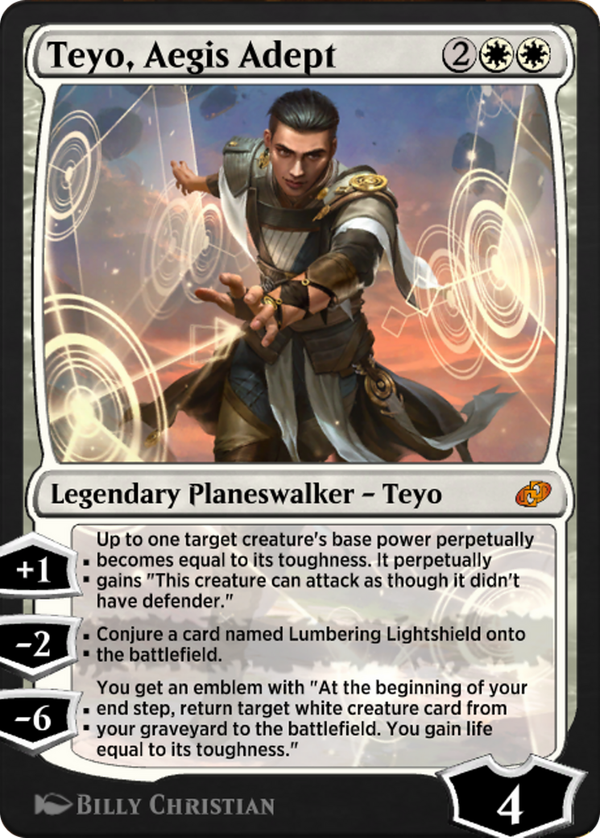
Teyo, Aegis Adept


A planeswalker built to exist inside a game engine, and its plus and minus both read the way they do because a client is keeping score. Conjure manufactures a card with no traditional printing, so Lumbering Lightshield lives entirely in the software, and Teyo's minus can only ever be a computed effect. That constraint shapes the plus, too. Perpetual power and toughness changes are a digital-native tool: the +1 rewrites a creature's base power to equal its toughness and grants it a way to attack despite defender, a modification that sticks through zone changes in a way paper templating cannot cleanly track without a mess of counters and reminders. The result is a coherent little archetype packed into one card: turn a fat wall into a fat attacker, conjure another wall to guard the planeswalker, and grind out the late game with an emblem that loops white bodies back for incidental life. It is the wall-aggro payoff white defenders had lacked, made possible by a rules layer that can enforce "perpetually" automatically. Whether this ever appears in cardboard is a question of what the physical game can practically track, not one of ownership or power level; the mechanics simply assume a computer is doing the bookkeeping.