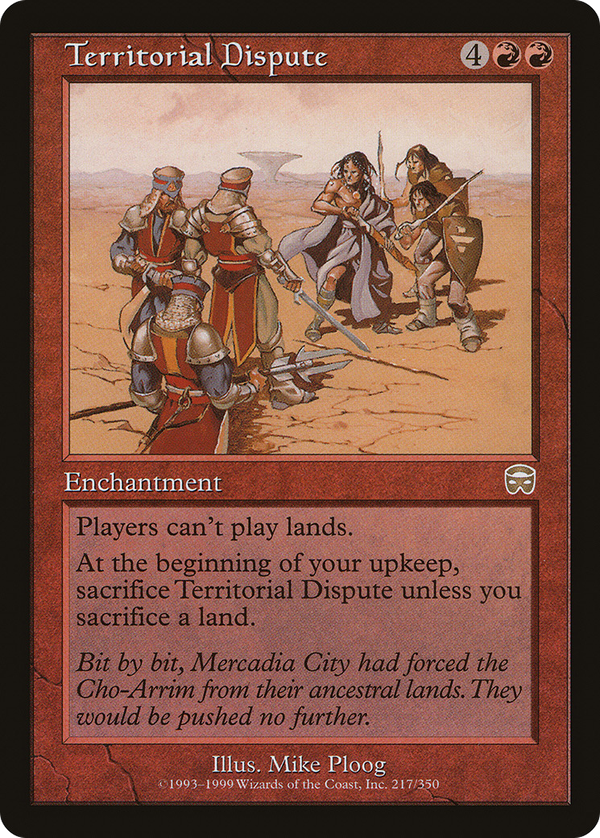
Territorial Dispute


Land destruction usually subtracts from one player; the "Players can't play lands" clause subtracts from everyone's future at once, freezing the board where it lands. That global no-rebuild rule is the real engine: nobody replaces what they lose, so opponents stay locked at the land count they had when the enchantment resolved. The discipline that keeps the design honest is the upkeep trigger, which taxes you and you alone: every turn it stays, you sacrifice one of your own lands or let the enchantment fall off. The asymmetry runs the wrong way, which is the whole point. You are the one paying to keep the prison standing, so the card rewards the player who can shrug off that self-inflicted attrition (a low-curve deck already done casting its spells) and punishes the player still trying to ramp into something. It is a prison piece dressed as land destruction, closer in spirit to Winter Orb than to Stone Rain: the goal is not to blow up one mana source but to lock the whole table into a resource desert and win the math. The fact that the upkeep cost falls on its controller rather than the table is also why it never warped a format the way one-sided lock pieces have. You have to want the desert badly enough to starve yourself for it, and most decks would rather just play their lands.