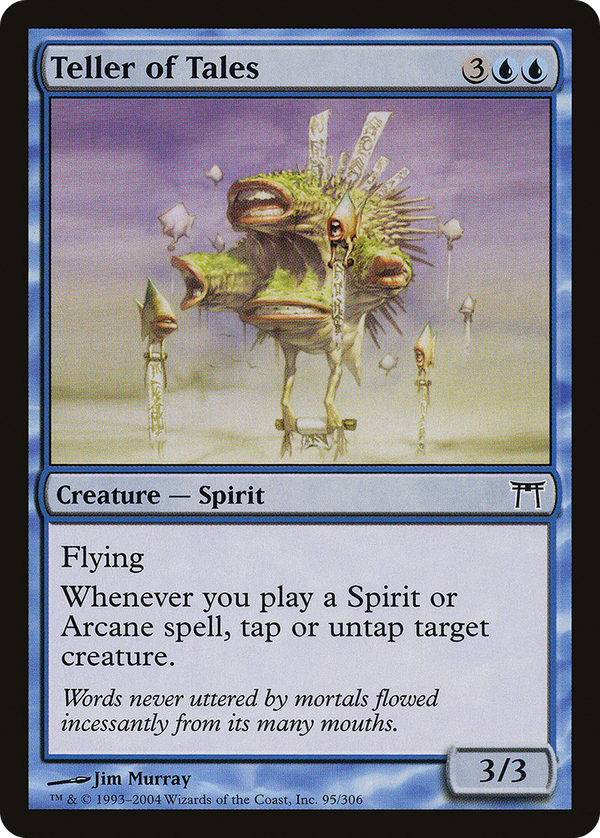
Teller of Tales


The tap-or-untap clause is the part doing the real work, and it cuts two directions at once: untap your own attacker to leave it back as a surprise blocker (a kind of free pseudo-vigilance), or tap down an opposing creature to clear the path before damage. Both modes fire off the same trigger, the one that reads off casting within the deck's two tribal-spell types, so a build chaining cheap creatures and small tricks fuels the engine as a byproduct of doing what it already wants to do. Note the boundary: because the trigger keys on casting, splicing a card onto an existing spell does nothing here, since splice never puts a new spell on the stack. The flying body is almost incidental, a clock that closes the game while the trigger handles the red zone. What makes the design notable is how it converts a tribal-synergy theme into combat tempo without ever attaching a number to the conversion. There is no counter cost, no life payment, no cap on how many times it fires in a turn; the only governor is how many qualifying spells you can actually cast, which is precisely the resource the surrounding deck is already maximizing. That self-reinforcing loop is the through-line: every additional spell the deck casts is another lever bending combat in your favor, a Falter effect or an untap stapled to spells you were already playing.