Teleport

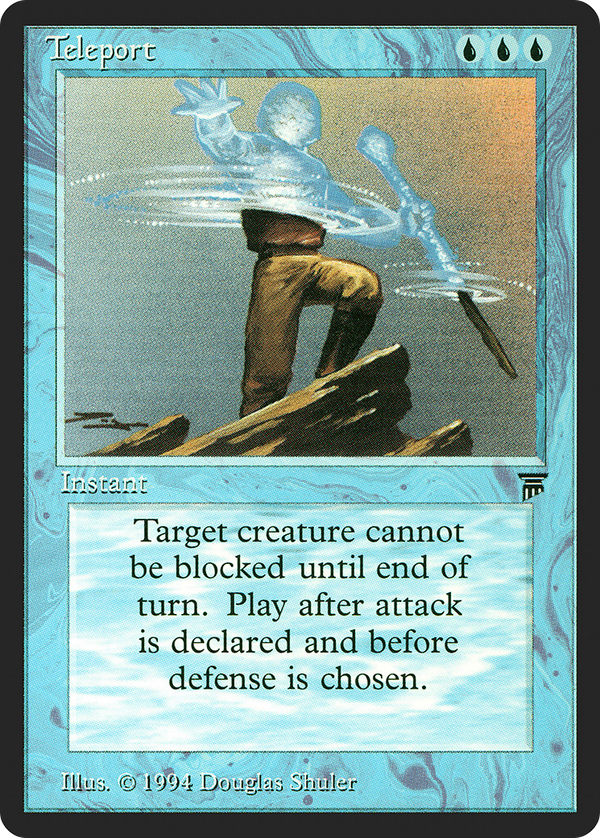
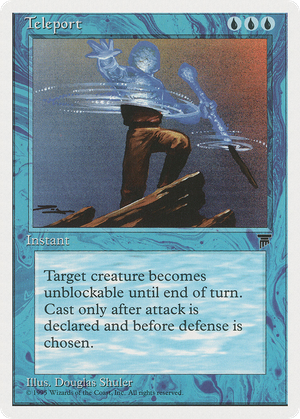
Triple-blue on an instant in 1994 is the design tell, but the real curiosity is the timing clause that has no obvious mechanical reason to exist. An instant that says "can't be blocked this turn" is already cast optimally during the declare-attackers step, before the defender chooses blocks; that is just how evasion tricks work. Hardcoding the restriction into the card does not change the strategic window so much as document it, freezing the spell into the one moment it was always going to be used. The interesting question is why the designers felt they had to spell it out at all, and the answer points at how primitive the timing language was in this era: rather than trust the rules to make the spell unproductive at other moments, the card narrows itself by fiat. It is an early experiment in using a step restriction as a design lever, a technique that would not come back into regular use until the modern era of step-specific triggers and intervening-if clauses, except here the lever barely does any lifting. The triple-blue, not the timing clause, is the actual cost of admission; it is the surcharge for guaranteed combat damage from a single creature, priced in a color that historically pays a premium for proactive evasion. Teleport reads today as an artifact of early Magic still sorting out which constraints were load-bearing and which were just the rules said out loud.