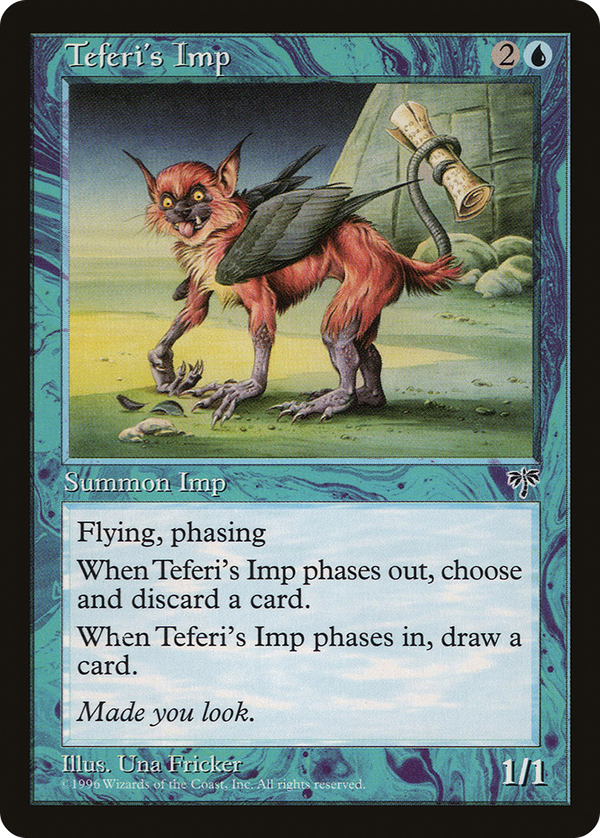
Teferi's Imp


Tie a hand-shaping ability directly to the untap step and you get a creature that loots on a clock you cannot switch off. The two halves of that engine are split across your turn cycle in a way that matters more than the net count suggests: the discard fires when the imp phases out, the draw a full turn later when it phases back in, so the even exchange over a turn pair masks a real tempo gap. You pay now and collect on the upswing, a rhythm that suits graveyard payoffs and end-step setup more than raw card flow. The 1/1 flier was never the point; nobody held back a board for it. The curiosity was the inevitability, a recurring discard-then-draw beat the controller had to plan around rather than activate, which also meant that running the hand dry turned the phase-out trigger into a dead exchange every cycle. Phasing has surfaced and receded across Magic's history, mostly as a protection or evasion tool, but few cards wired a recurring cost-and-payoff straight onto the phase transitions the way this one did. It remains one of the cleanest demonstrations of what the mechanic was reaching for: a creature that manages its own appearances, with consequences bolted to each vanishing and return, and of why that idea was both clever and awkward to build a deck around.