Tectonic Instability


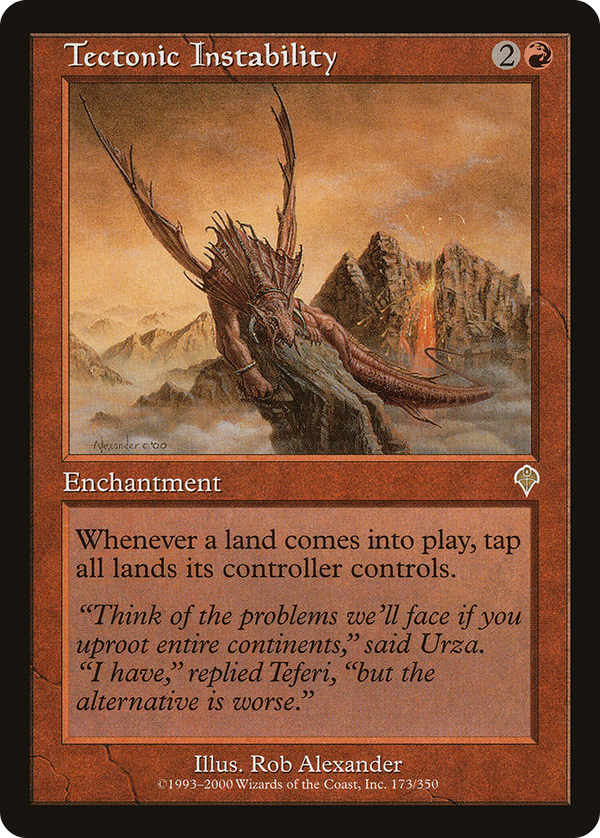
Drop a land and your whole battlefield freezes. The trigger collects every land entering play, not just the once-per-turn drop, and it taps the lands belonging to whoever played that land. That symmetry is both the problem and the appeal: a deck that wants to drop a land and then spend the rest of its mana that turn instead watches the land drop cage everything it controls until the next untap. The card punishes players who keep touching their lands after they have already deployed; fetch effects, ramp, and land recursion all become self-inflicted lockdowns for whoever runs them, including you. The way to sit on the right side of it is to stop caring about untapped lands entirely: float your mana, empty your hand, commit your threats before the cage closes, and let the opponent's instinct to keep curving out do the work. It sits among the land-tapping prison pieces that try to turn the most automatic action in Magic into a liability, and it does so without choosing a target or asking for an activation: the trigger simply collects whoever puts a land into play, friend or foe. The weakness is that the asymmetry has to be manufactured by your own discipline rather than printed on the card, which is fragile and easy to disrupt, so this lives at the fringe of lock strategies rather than the center of any of them.