Tavern Swindler


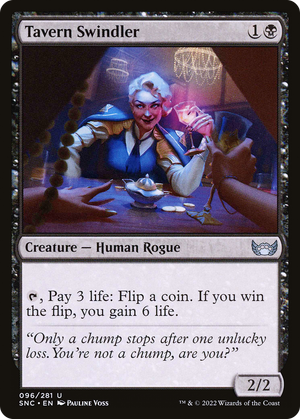
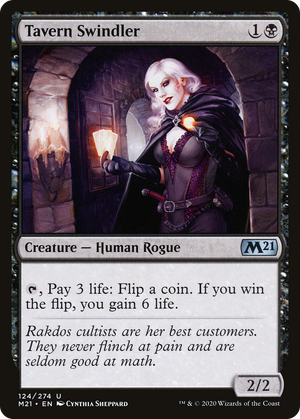
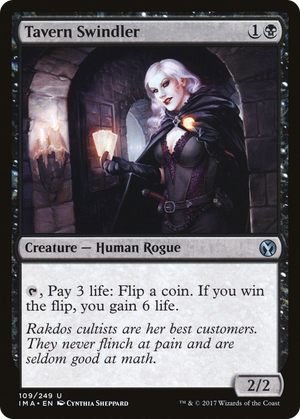
Coin flips are the design space Magic keeps quarantining, and this is one of its most honest expressions: pay 3 life up front, then flip for 6 back, with the tap cost rationing you to once per turn. The math is the joke. Win and you net 3 life on a roll; lose and you have simply paid 3 life to do nothing, since the activation cost is non-refundable whether the coin cooperates or not. That asymmetry (you pay first, you find out second) is what separates a coin-flip card from a deterministic lifegain spell, and it is exactly the friction that keeps the effect off the rails. Nobody is attacking with this; the card is a button, not a beater. What gives it a second life beyond the gimmick is the population of cards that fix or double coin flips, since they convert a fifty-fifty engine into a reliable one and turn the printed downside into a payoff. On its own it is a parlor trick that loses you the game as often as it stabilizes it. Bolted onto a flip-matters shell, the repeatable activation becomes the point: a recurring life-swing that no longer asks you to gamble. The name and the rake's-eye art commit fully to the conceit, which is the right call. A card whose entire function is wagering should look like a wager.
Rules text
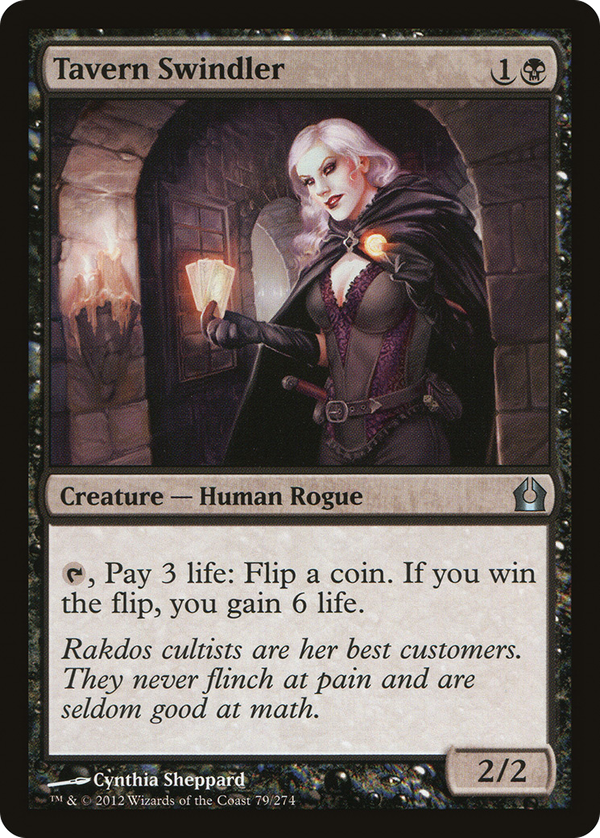
 , Pay 3 life: Flip a coin. If you win the flip, you gain 6 life.