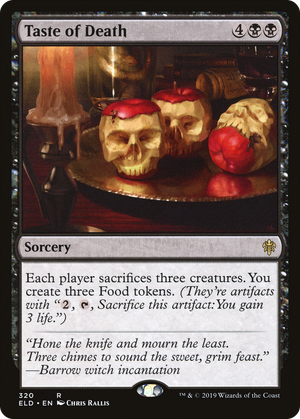
Taste of Death


Symmetrical edicts are old technology; the wrinkle here is the asymmetry hidden inside a symmetrical frame. Each player sacrifices three creatures, but only the caster walks away with the Food, which turns a mutual board-clear into a resource swing. Those three Food tokens arrive unconditionally, and that unconditional payoff points at the kind of deck this was built for: one where sacrifice fodder is cheap. When your board is stocked with tokens or expendable bodies, the three creatures you feed the edict were never meant to survive anyway, and you convert the whole exchange into a delayed nine-life buffer that also fuels whatever cares about Food or artifacts. That reframes the card from a Diabolic Edict variant into an engine piece. The cost is where the honesty lives: six mana and a full clause of self-sacrifice make this the opposite of a tempo play. You are not answering a single threat efficiently; you are trading three of your own creatures to strip three of theirs and banking a lifegain payload regardless, a rate that only makes sense when your creatures are liabilities you wanted gone. It is a mass edict for the grindy end of the game, priced so that it never doubles as spot removal on an even board.
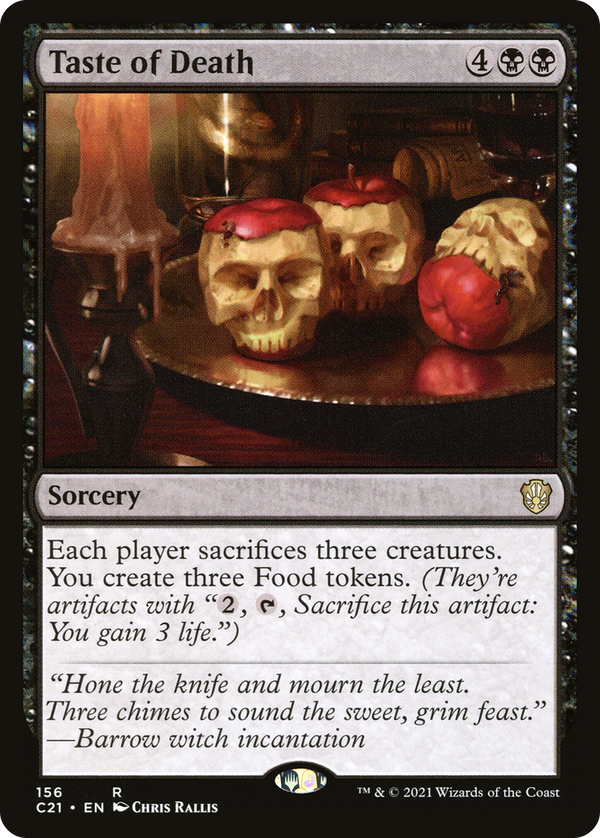
Rules text
 ,
,  , Sacrifice this token: You gain 3 life.")