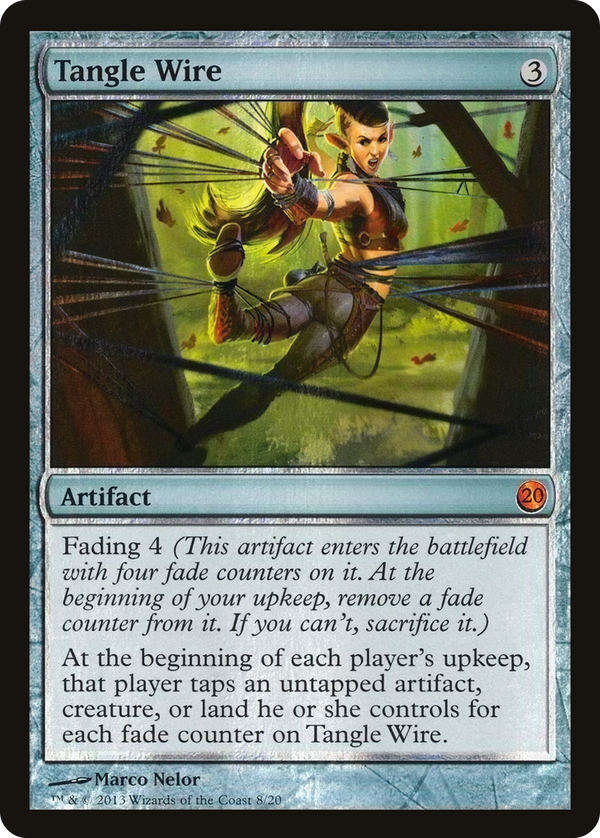
Tangle Wire

The genius of the design is that it taxes everyone, including the player who controls it, but the symmetry is only skin deep. The trick is stack ordering and the right to tap Tangle Wire itself. On the controller's upkeep, the fade-counter removal and the tapping trigger both go on the stack at once, and a careful pilot resolves the fade removal first so the tapping counts one fewer counter, then taps Tangle Wire itself along with permanents already committed to the lock, sequencing the clamp around their own development. The opponent still chooses which untapped permanents to tap, but they get no such relief: their upkeep arrives with the board fresh and the clamp tightening at the worst possible time, every relevant land and mana source frozen before they can spend it. Four fade counters means four permanents locked early, three the next turn, and so on, the grip loosening exactly as a prison deck finishes assembling whatever it was building toward. Fading is the structural pressure valve that makes the rate honest: this is not a permanent stax piece but a stopwatch, ticking down to its own sacrifice over four upkeeps, which is why a three-mana artifact can hand this much tempo to one side without breaking open. It asks a precise question of its pilot: can you convert four turns of asymmetric tapping into a closed game before the counters run out? Built correctly, the answer is a stutter-step the opponent never recovers from.