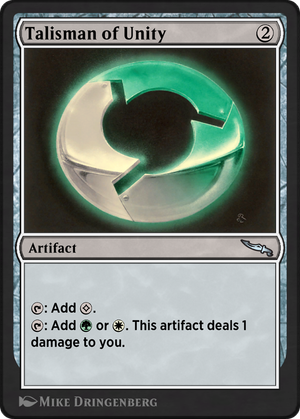
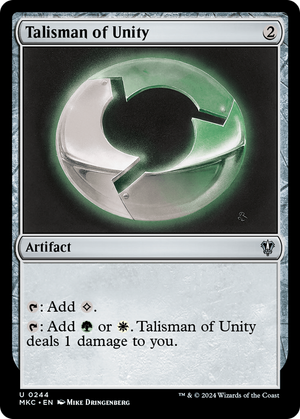
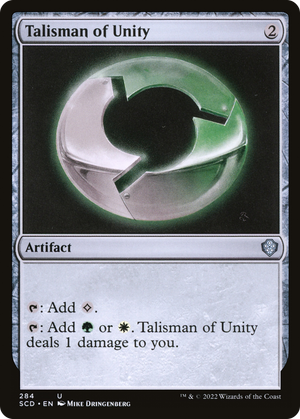
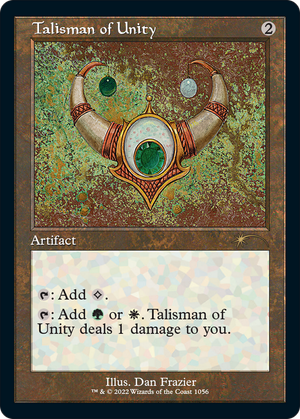
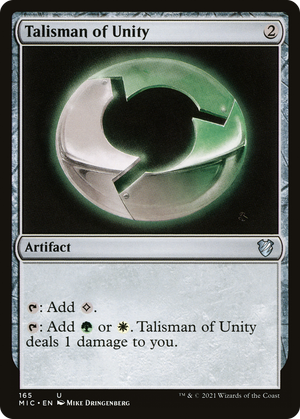
Talisman of Unity

The Selesnya member of Mirrodin's Talisman cycle, and like its siblings it solves a fixing problem by charging in life instead of in tempo. The colorless tap is free; the colored tap costs one life every time you reach for green or white. That tradeoff is the whole structure of the cycle: a two-cost rock that ramps and fixes at once, paid for not with entering tapped (the Signets and tapland conventions of the era) but with a slow self-inflicted bleed you choose to pay only when the deck demands a specific color. The design lineage runs straight back to the original mana artifacts of early Magic, but the Talismans found the sharper knob: separate the painless colorless mode from the painful colored mode, and let the pilot decide which they need turn to turn. In a deck that mostly wants to accelerate, the life never gets paid; in one straining its mana on the colored pips, it adds up. That conditional cost is why these rocks have aged better than a flat enters-tapped clause: the price scales with how greedy you are, and a player ramping hard in two colors barely notices it. Green-white never had a shortage of two-mana ramp options, but few of them double as fixing for both pips, and that dual function is what keeps this one in the conversation.
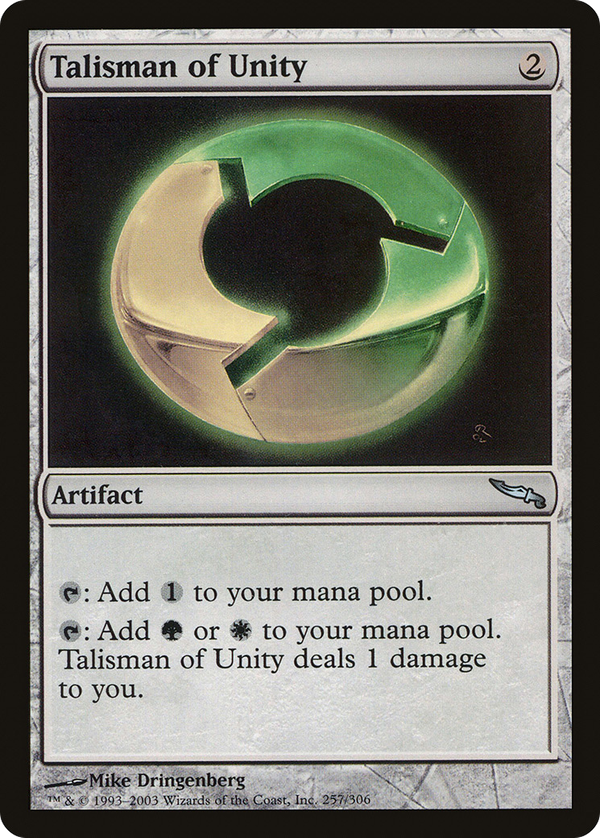
Rules text
 : Add
: Add  .
: Add
.
: Add  or
or  . This artifact deals 1 damage to you.