Talion's Messenger


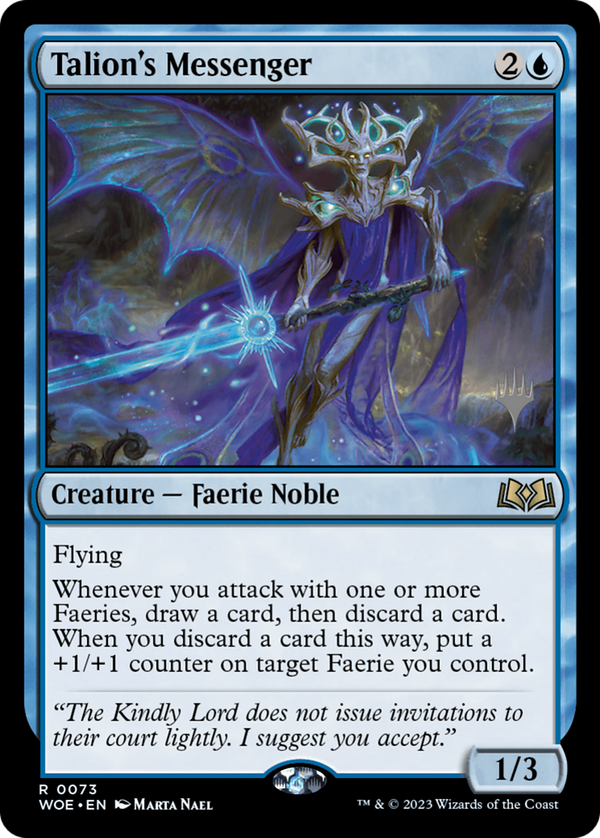
The tension in a Faerie tribal payoff is that the deck wants to keep its swings cheap and frequent, while card-filtering engines usually want you to slow down and durdle. This one refuses the trade by tying its filtering to the attack step itself: you get the loot as a reward for doing what a tempo deck already wants to do. The clever piece is the second clause, which turns the discard from a cost into fuel. Looting normally forces you to pitch a card you would rather have kept; here, every discard converts into a permanent +1/+1 counter, so the "downside" of the effect grows your board instead. That reframes the whole engine. Rather than paying a card to dig, you are spending your worst card each turn to build a bigger evasive threat, which suits a flash-and-tempo shell that would happily bin excess land or a redundant flier. The body is deliberately fragile (a 1/3 flier) because a repeatable draw-and-grow engine cannot also sit on the sturdy end of the curve. The catch is the trigger condition: you have to actually be attacking with Faeries, so the card does nothing while you hold up counterspells, and it rewards the commitment of turning creatures sideways. Leave it unanswered across a couple of attack steps, though, and the counters accumulate on evasive bodies faster than the filtering alone would suggest, doing the work of both smoothing your draws and closing the game.