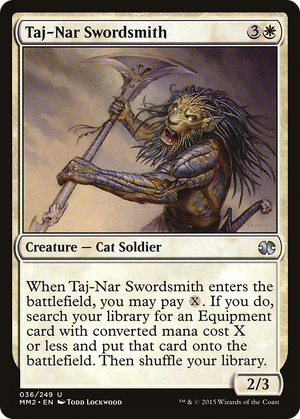
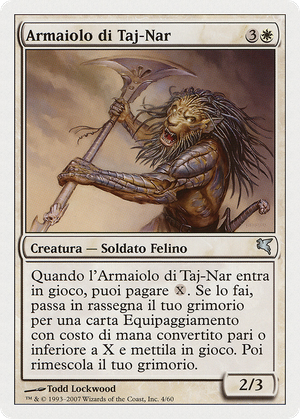
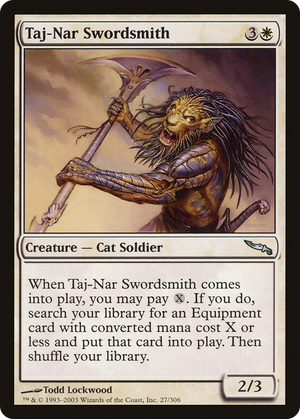
Taj-Nar Swordsmith


Tutoring an Equipment directly onto the battlefield, rather than to hand, is the trick that justifies the body: the X-payment fetches the gear already in play, attached to nothing but past the cast step entirely. That distinction does the heavy lifting. A pure search-to-hand effect leaves you a turn behind, still owing the cast; putting the Equipment onto the battlefield means the only tax left is the equip cost. The X scaling is the constraint that pays for the flexibility: a cheap utility piece costs almost nothing on top of the four-mana shell, while a heavy game-ender demands you bank the mana to find it, so the same card flexes from an early toolbox enabler to a top-end finisher depending on what the board needs. As an Equipment fetch printed in the era that introduced the subtype, it answers a problem the mechanic created: the best gear was often the most expensive to assemble, and consistency mattered once an artifact-matters deck wanted a specific weapon every game. Whether the target is mana ramp, evasion, or a hard payoff, the Swordsmith converts a 2/3 enter-the-battlefield trigger into a deck's most reliable line to its single most important piece of equipment.
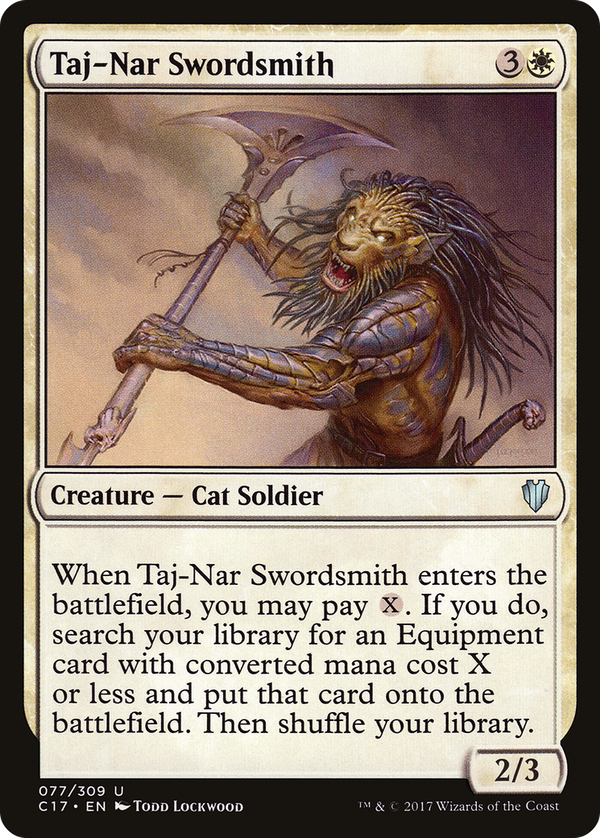
Rules text
 . If you do, search your library for an Equipment card with mana value X or less, put that card onto the battlefield, then shuffle.