Szarel, Genesis Shepherd




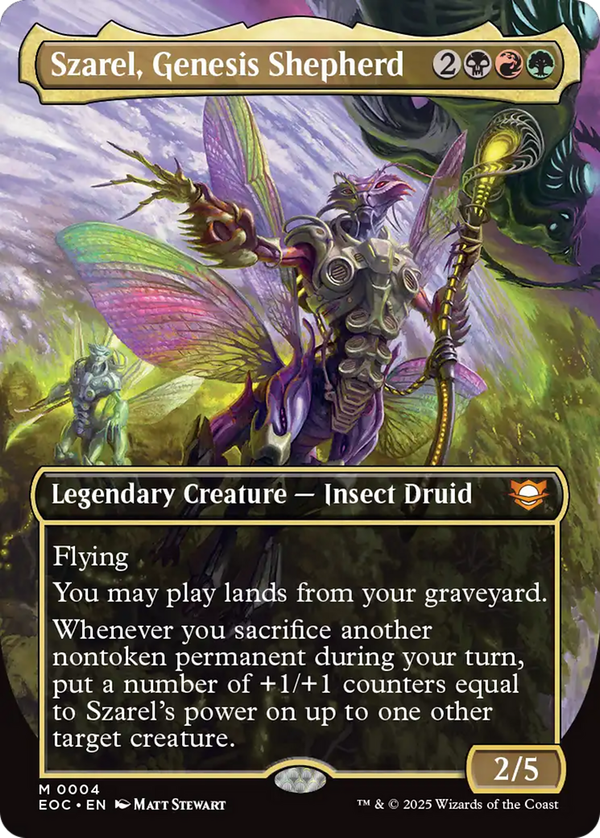
The counter payoff is where the machinery gets interesting: sacrifice a nontoken permanent on your turn and the reward scales with Szarel's own power, so the more you invest in growing the body, the more each sacrifice hands out. But the trigger reads "up to one other target creature," which is the restriction that shapes the whole engine. Szarel cannot fatten itself off its own triggers; the counters have to land on a teammate. That turns the deck into a distribution problem rather than a solitaire loop: you are choosing, sacrifice by sacrifice, which creature to build into a threat, and the shepherd stays a modest 2/5 unless something else grows it. That separates it from the usual aristocrat commander, which converts sacrifices into drain or card draw at a fixed rate; here the payoff is elastic and directional, and the deck's ceiling is a function of how large the recipient becomes. The land-recursion clause is the quieter half, and it does more than ramp: sacrifice-matters shells burn through permanents fast, and fetchable or sacrificial lands become repeatable fodder when the graveyard is a second hand rather than a dead zone. Read together, the two abilities describe a permanent-attrition engine that never runs out of things to throw away, with a flying body that survives the carnage around it. The Jund color identity is the honest cost: this wants fodder, outlets, and recursion, and while it recurs its own lands, the fodder and outlets it does not itself supply.