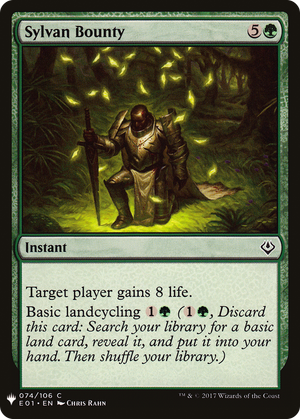
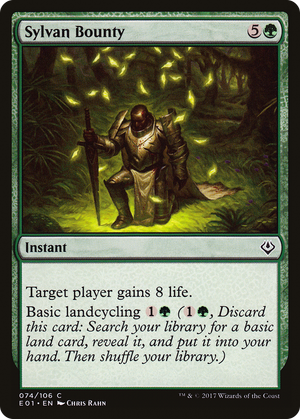
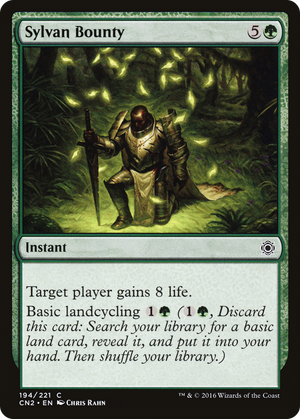
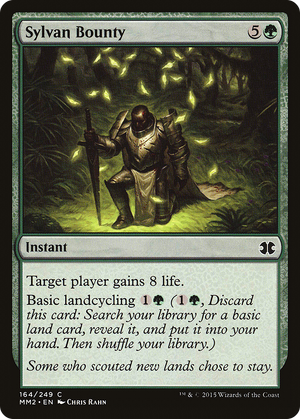
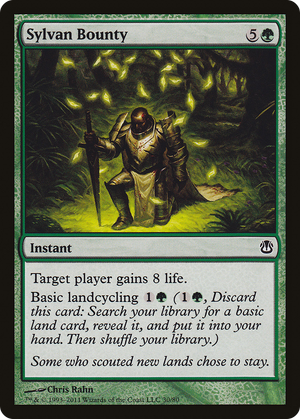
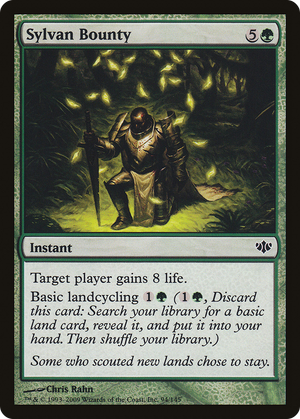
Sylvan Bounty


The whole point of the cycling lifegain cards is that they refuse to be a dead draw. Eight life for six mana at instant speed is not a rate anyone builds toward; in a topdeck war or a flood-out, it is exactly the kind of card you would normally curse to find. The basic landcycling clause is the escape hatch: when you do not need the life, you pay  , discard the card, and pull a basic from your library, smoothing your draws instead of stranding a card that would otherwise sit dead. That dual nature is the design idea: a spell whose floor is set deliberately high so the ceiling can stay irrelevant. Cycling has always traded a small mana tax for the right to ditch a card and dig, and basic landcycling narrows the search to a basic so the cost can stay cheap. What makes this version worth a second look is that the two modes point in opposite directions: cast it and it is a bulk life buffer for the late game; cycle it and it is mana fixing for the early one. The two never overlap, because cycling spends the card as a cost: once you discard it to fetch the land, the lifegain is gone for good. It is a card built to be useful at both ends of a game and unremarkable in the middle, which is exactly the contract cycling was invented to write.
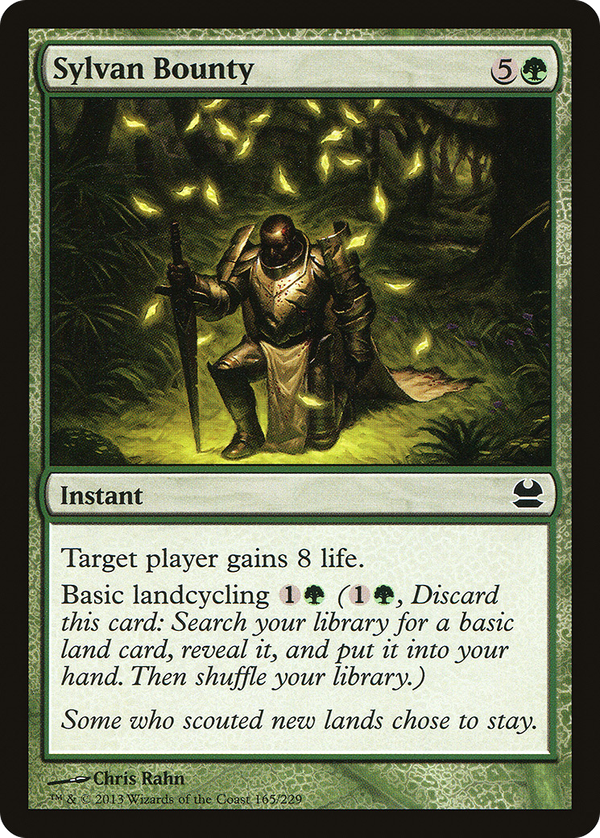
Rules text
(, Discard this card: Search your library for a basic land card, reveal it, put it into your hand, then shuffle.)