Sword of Hours

The counter accumulation is only the setup; the payoff is a variance engine bolted onto combat. Most Equipment that grows a creature does so linearly: one attack, one increment, a slow snowball you can plan around. This one attaches a dice roll to that snowball and turns every connection into a swing at exponential growth. The doubling condition is a d12 clearing the combat damage dealt, which means the equipment is easiest to break early, when the creature is small and the roll only has to beat a low number, then gets harder to double as the counters pile up and the damage climbs. That inverted difficulty curve is the actual design: the card front-loads its luck, rewarding you for swinging with a fresh recipient before the toughness of the threshold outruns your die. The floor is a guaranteed +1/+1 per attack, so a whiff never feels like nothing; the ceiling is a creature that doubles from four counters to eight to sixteen across successive turns, a runaway state that ends games out of nowhere. It sits in the lineage of dice-driven artifacts built for tables that want their combat math to include a gasp, where the honest linear growth is the safety net and the roll is the reason you equipped it in the first place.
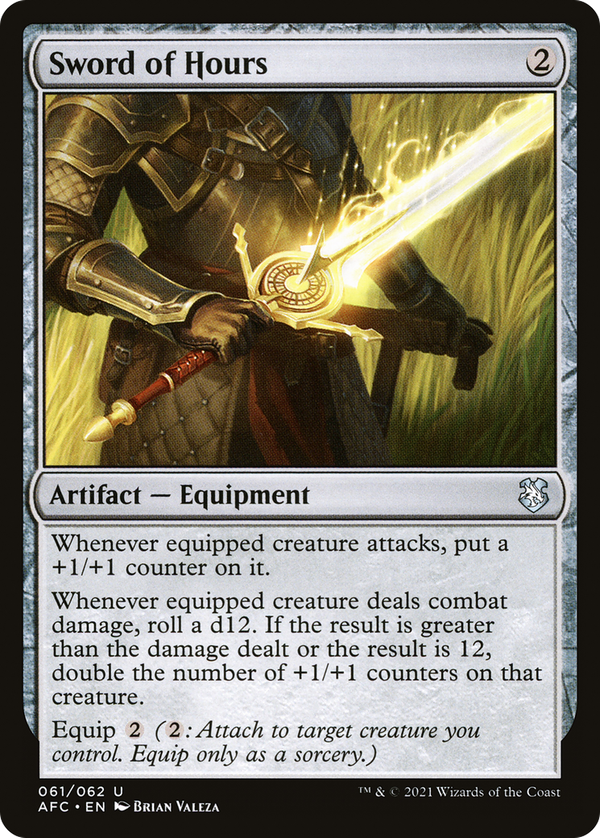
Rules text
(: Attach to target creature you control. Equip only as a sorcery.)