Swaggering Corsair


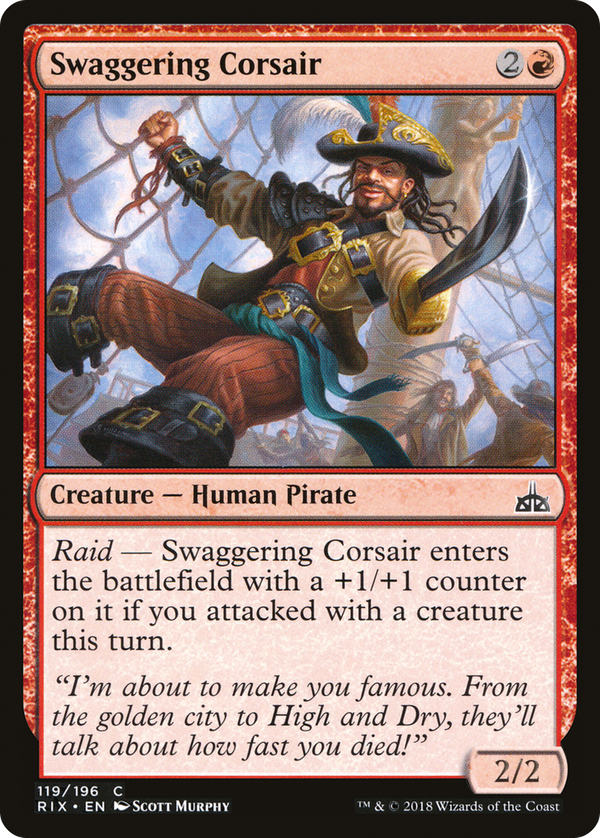
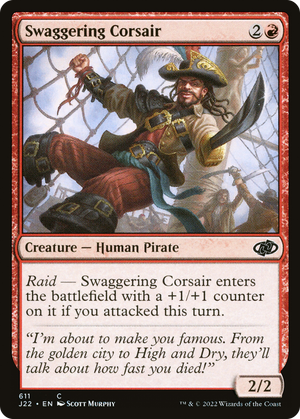
Raid is one of the more honest mechanics red has been given: it pays you for doing the thing your deck already wants to do, and it costs you nothing when you cannot. Here the reward is modest and the price is a single condition. Cast it on an empty board, before combat, or off a turn where you held back, and it is a plain 2/2. Cast it after you have declared even one attacker this turn, and it enters with a +1/+1 counter, a 3/3 that blocks better and survives more of the exchanges a beatdown deck runs into. Notice how the condition is written into how the creature enters, not layered on as a trigger you have to resolve: whether the attack connected or the attacker lived is irrelevant, because the game only checks whether you declared an attack before this hit the battlefield. That quietly rewards the player who swings in when the math is close. The design lives entirely in sequencing. The card never tells you to attack; it simply enters bigger if you did, so the upside accrues to the player already pressing tempo and evaporates for the player on the back foot. That conditionality is what lets red print an aggressive body whose ceiling only shows up in an aggressive game state. As a creature it is curve filler, with a Pirate type that mattered more to its tribe than the stat line ever did. But it is a clean teaching example of why raid was built the way it was: the reward is real, the check is automatic, and the cost is borne entirely by decks that would not have wanted the card anyway.