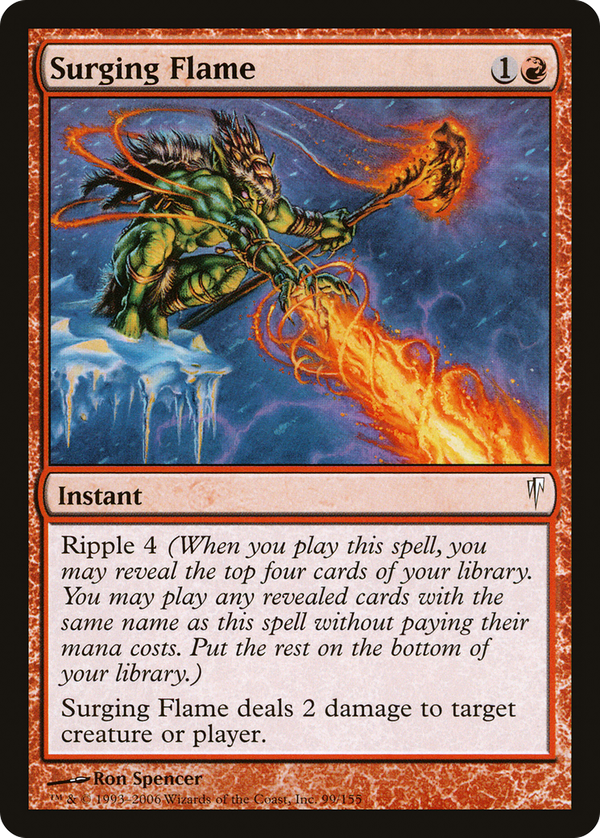
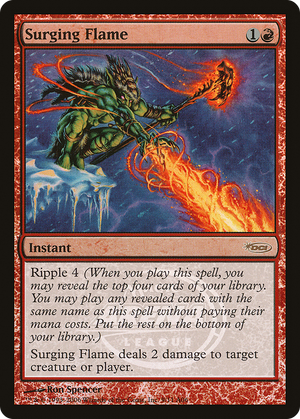
Surging Flame


Two damage to any target is a fixed, unremarkable rate; what the design is actually selling is the lottery wrapped around it. Ripple reveals the top four cards on cast, and any copy of this exact spell among them comes down free, which means the card stops being a single removal spell and becomes the engine of a deck built to chain its own name. The reward is steep, and the variance is the price: stuff a library with the maximum legal count of Surging Flame, draw nothing else, and a single cast can cascade into a burst of free burn; salt that same library with other cards and most casts ripple into dead reveals that get buried on the bottom. This is a mechanic that punishes diversification, an unusual axis for a constructed deck to live on, and a deliberate experiment in whether a deck built around four-of redundancy could be pushed all the way to a single-card obsession. The structural cousin is cascade, which also looks at the top of the library and casts for free, but cascade rewards a curve full of variety while ripple rewards the opposite: a stack of identical names. Where cascade asks for diversity beneath a high-cost spell, ripple asks for monotony, and that inversion is the entire conceptual hook, with a cheap burn spell standing in as the proof of concept.