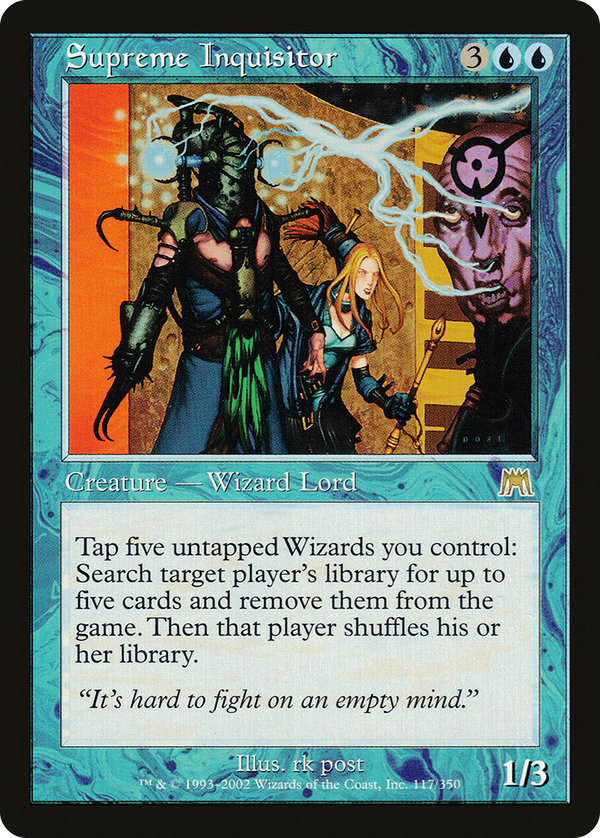
Supreme Inquisitor


The tribal scaffolding of its era built toward payoffs that asked for a real board commitment, and this one demanded the steepest entry: not the tap of a single creature, but five untapped Wizards spent at once to strip five cards from a library and exile them. That cost is the whole design tension. A 1/3 for does nothing on its own; the ability only fires once you have assembled a board wide enough that tapping five Wizards is plausible, so the card sits at the top of a tribal curve rather than greasing it. Where most library disruption of the period attacked one card at a time, this reached for a surgical five-card extraction from any player's deck. Because the ability searches, the controller sees the whole library when it resolves: this is a precision strike, not a blind one. You can pull a combo's specific assembly pieces, tear out a tutor target before it can ever be found, or gut the cards an opponent has carefully drawn toward. The mandatory shuffle that follows is the honest part of the bargain, denying any temptation to also reorder what remains. It is the unusual piece of disruption that scales with a tribe instead of with mana, a creature-count problem masquerading as a card-advantage threat. Five bodies tapped, and the opponent loses five cards they may never have realized were the ones holding their deck together.