Sunbeam Spellbomb

The cleverness of the Spellbomb cycle was the deferred decision: pay one mana to deploy the artifact, then let the question of what it does wait until the board tells you the answer. This one splits white lifegain against a colorless cantrip, and that generic-cost draw is what keeps the floor off the ground: any deck can crack it for a card regardless of its colors, so the artifact is never a true dead draw. It is never free either. Casting it costs one mana, and replacing it from hand costs another, so the draw mode is a two-mana investment to dig one card deep, not a frictionless cycler. You pay that toll for the held option more than the raw card advantage. The white activation asks even more relative to its rate: five life off a sacrificed one-mana rock is a steep ask, worth taking only when the clock genuinely justifies it. The two modes are not symmetric in card economy: the cantrip replaces itself in hand, while the lifegain spends the card outright with nothing back. The design lesson the Spellbombs taught was that a cheap artifact need not commit to a job at deployment. It can sit as a stored choice that resolves into whichever half the situation rewards, and the player pays for that flexibility twice: once to play it, and again to decide which sacrifice to spend.
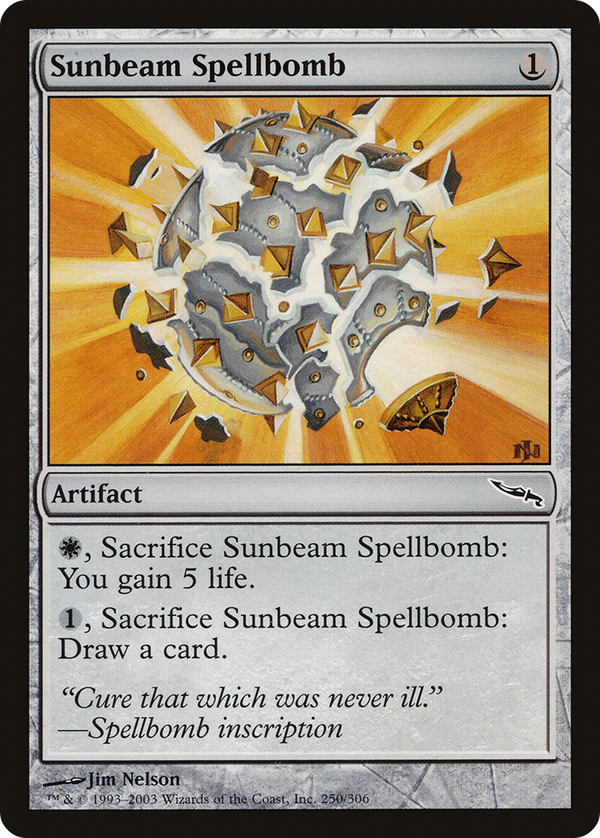
Rules text
 , Sacrifice this artifact: You gain 5 life.
, Sacrifice this artifact: Draw a card.
, Sacrifice this artifact: You gain 5 life.
, Sacrifice this artifact: Draw a card.