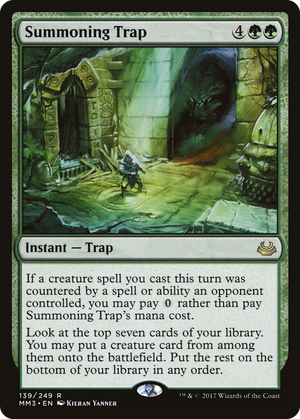
Summoning Trap


Counterspell is supposed to be a clean answer: spend a little mana to erase a threat and bank the tempo. This design turns the act of countering into the thing that arms the payoff. Cast a fat creature, let the counter resolve, and at any later point that same turn you may pay nothing to dig seven deep and slam a creature directly onto the battlefield. The free cast inverts the trade: the opponent's interaction becomes the trigger for a Polymorph-style cheat that costs them more tempo than it cost you. The dig stays honest, though. You look at seven and commit to a single creature, not whatever you want, so without a setup spell the effect is a search, not a guaranteed cheat-into-anything button. The puzzle is that its two halves want opposite things: the free cost wants your best creature already countered and gone, while the dig wants your best creature still buried in the library. Building to satisfy both means stacking redundant threats to bait the counter and packing enough payoff creatures that the search still hits after one is spent. The clause is a bonus, not a requirement: against an opponent who never points a counterspell at you, you simply pay and run it as a slower reanimation-free creature finder. Against one who leans on counters as their primary interaction, it flips the matchup, turning their most reliable tool into a liability.
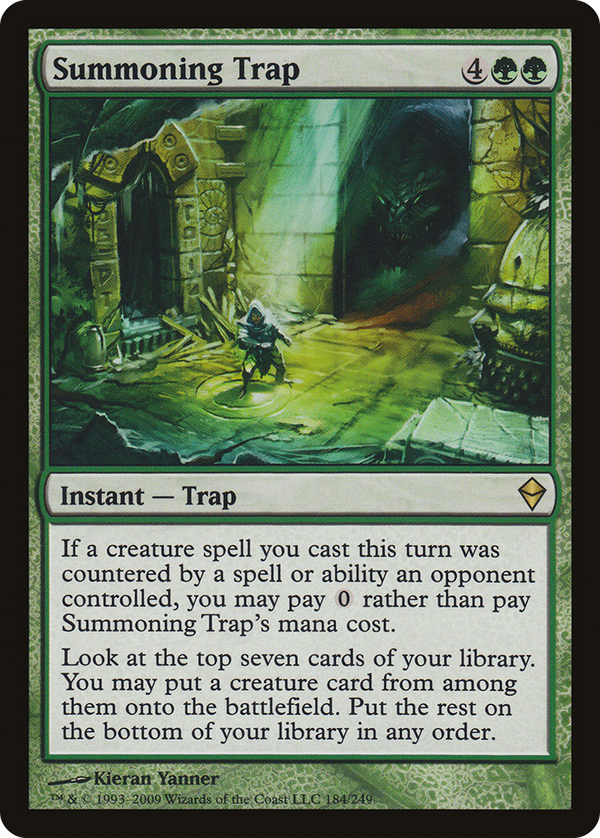
Rules text
 rather than pay this spell's mana cost.
Look at the top seven cards of your library. You may put a creature card from among them onto the battlefield. Put the rest on the bottom of your library in any order.
rather than pay this spell's mana cost.
Look at the top seven cards of your library. You may put a creature card from among them onto the battlefield. Put the rest on the bottom of your library in any order.