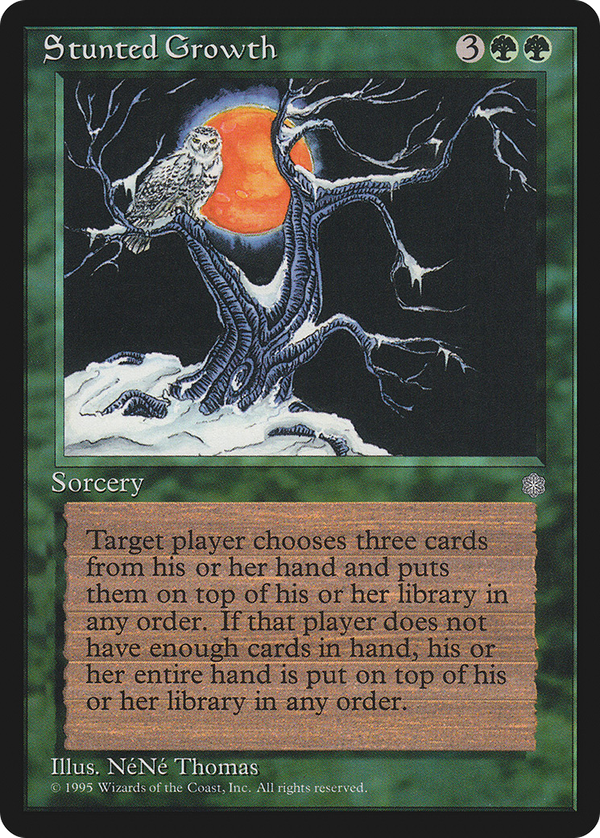
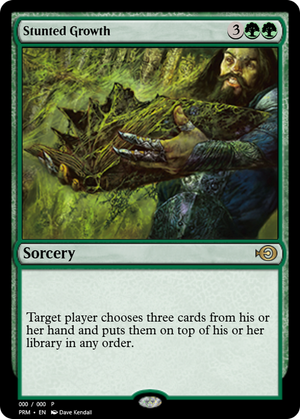
Stunted Growth


Denial through inversion: instead of stripping cards from a hand the way Mind Twist or Hymn to Tourach does, this preserves the target's card count while taxing their ability to develop. The three chosen cards still belong to the player, but they have to draw past them one by one before anything new arrives, undoing recent draws and locking the next several turns into known, unwanted picks. The friction lives in the ordering clause: the target chooses which three and in what sequence, so the worst case is partly self-inflicted, which keeps the effect from being a clean prison. Where it has always struggled is tempo. At five mana, sorcery speed, it does nothing to the board and nothing to the opponent's current threats; it taxes a future that a developed opponent may not need. That places it among the early green experiments to hand the color a disruptive, hand-and-library-attack role it was never temperamentally suited for, a direction Wizards mostly abandoned before settling green's identity around ramp, creatures, and combat. The effect is memorable precisely because it is strange: a green sorcery that touches an opponent's library at all, doing soft denial in a color that has spent the rest of its history avoiding the question.