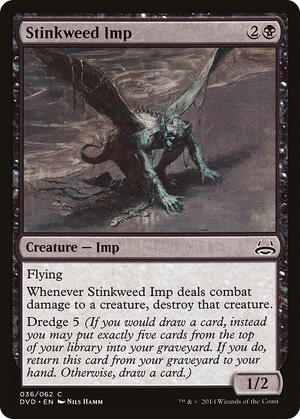
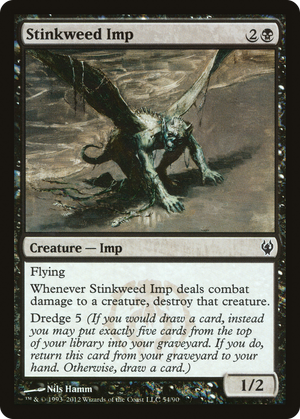
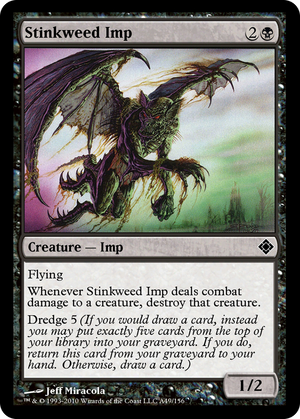
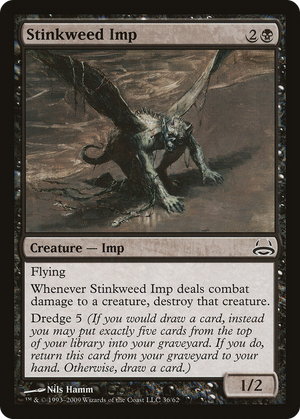
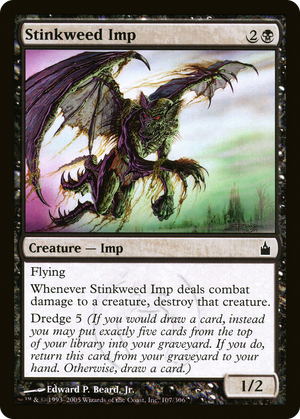
Stinkweed Imp


Dredge took the oldest card-advantage problem in the game (drawing cards thins your library toward the bottom) and made it the engine: the resource you spend to refill is the resource that fills your graveyard. Dredge 5 is the steepest version of that bargain. Every time you would draw, you may instead mill five cards to return this from the graveyard to hand, which means each replay buries five more cards' worth of fuel exactly where a graveyard-centric deck wants it. That self-replicating loop is the whole reason to run it. A flying 1/2 that destroys any creature it deals combat damage to is a passable deterrent: it trades up against ground threats and walls fliers, but nobody picks it for the combat math. They pick it because the high dredge number, a drawback in any deck that actually wanted to draw, becomes the point in any shell built to stuff the yard quickly: threshold counts, recursion targets, payoffs that reward cards being in the graveyard rather than the library. The tension dredge resolves is that card flow and library depletion usually pull against each other; here they are the same action, and the deckbuilder decides which one matters. That inversion, where the cost of reusing a card and the work the card does are identical, is what made this the workhorse of an archetype that treats drawing as optional.
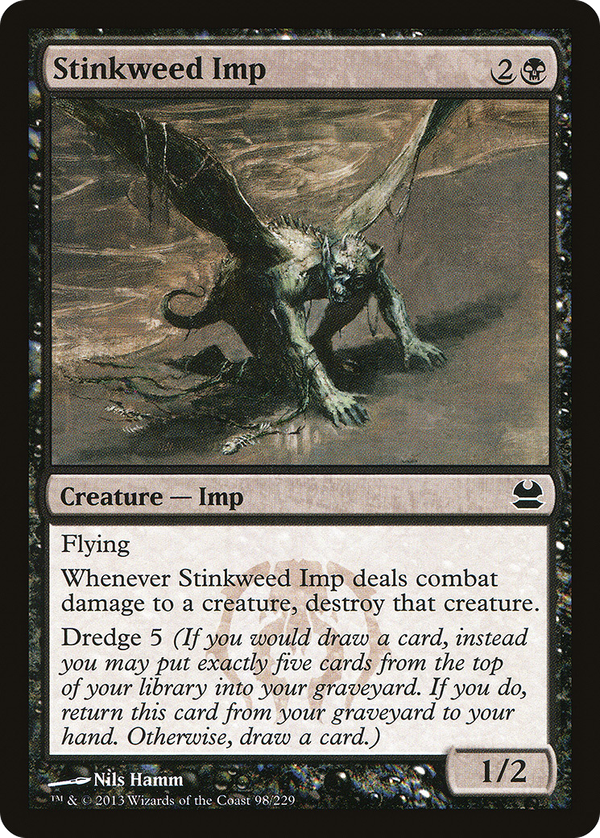
Rules text
Format Status
More formatsFewer formats
Other printings
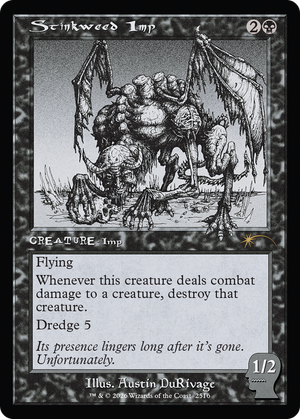
- Secret Lair Drop#2516
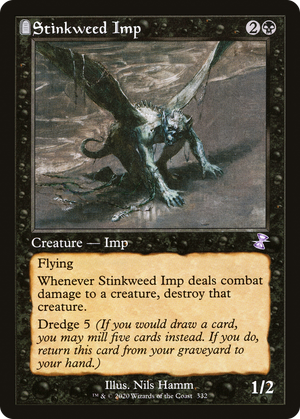
- Time Spiral Remastered#332
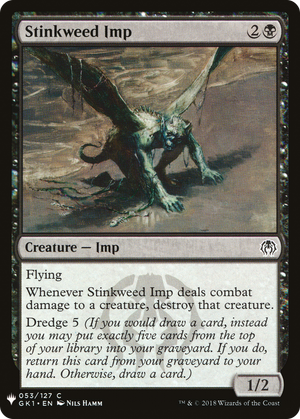
- The List#GK1-53
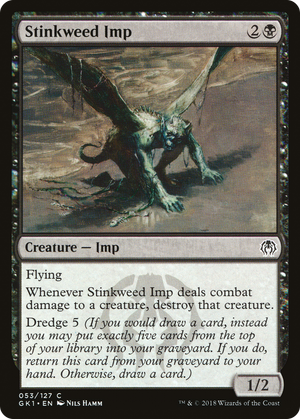
- GRN Guild Kit#53
- Duel Decks Anthology: Divine vs. Demonic#36
- Duel Decks: Izzet vs. Golgari#54
- Magic Online Theme Decks#A49
- Duel Decks: Divine vs. Demonic#36