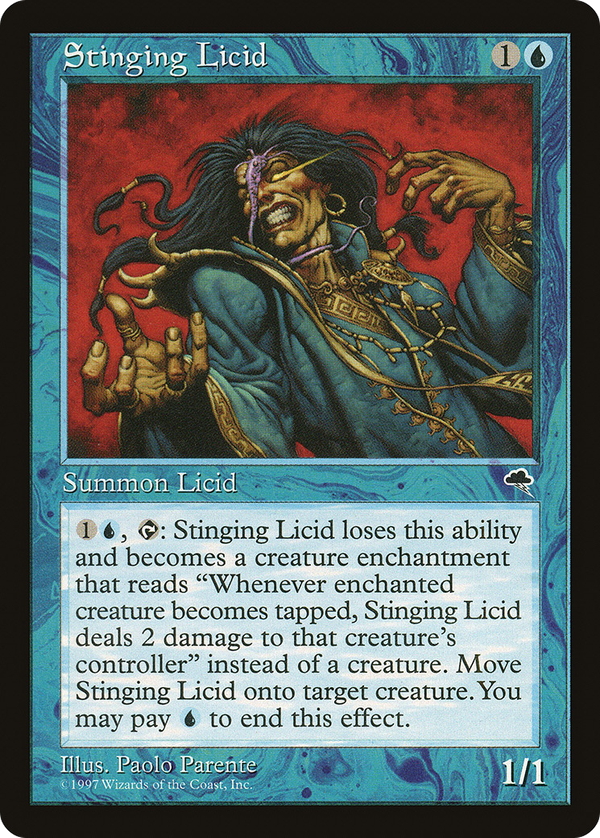
Stinging Licid


Punishment that follows the action around the board: the payoff fires whenever the enchanted creature becomes tapped, which means it taxes the most ordinary things a creature does (attacking, activating a tap ability, getting tapped down by an opponent's effect) and then refuses to commit. Because the suiting-up cost can be undone with a single blue payment, the Aura is never truly stuck on one body; it can peel off and reattach to whichever creature is about to commit to combat next turn, turning a fragile 1/1 into a repositionable tax engine. That detachability was the Licids' defining trick: an enchantment that voluntarily becomes a creature again was nearly unprecedented and largely abandoned afterward, which is why the rules engine of the era had to scramble to support a body that could keep flickering between two card types. The cost is the rate. The body asks for mana to put on its Aura clothes and only pings for 2 each time the target taps, so the damage accrues slowly and demands a board state where tapping happens constantly. What looks like a marginal creature is really a slow, mobile clock that wants a grindy, attrition-heavy table to do its work, where the controller can keep moving it onto the next creature foolish enough to turn sideways.
Rules text
,  : This creature loses this ability and becomes an Aura enchantment with enchant creature. Attach it to target creature. You may pay to end this effect.
Whenever enchanted creature becomes tapped, this creature deals 2 damage to that creature's controller.
: This creature loses this ability and becomes an Aura enchantment with enchant creature. Attach it to target creature. You may pay to end this effect.
Whenever enchanted creature becomes tapped, this creature deals 2 damage to that creature's controller.