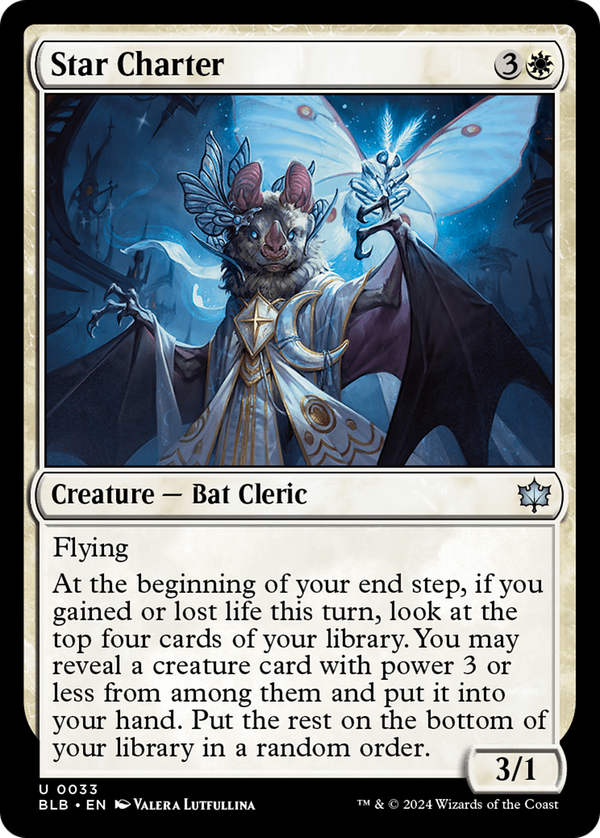
Star Charter


Look closely at the condition on that end-step dig: gained or lost life this turn. That disjunction is the entire design, and it quietly severs the card from needing a dedicated lifegain engine to fire. A fetchland crack, a painland tap, a Phyrexian mana cost, an incidental point of drain against you: any life swing in either direction satisfies it, so the filter recurs in decks that never set out to gain a single point. What it hands back is narrow by rate but sharp in scope: a look at the top four for a creature with power three or less, which plays as the deck's own curve refilling itself turn after turn. The 3/1 flying body is fragile and mostly beside the point; the value is the recurring end-step dig, kept deliberately cheap so it can run every turn. Where most lifegain payoffs demand you assemble a life-total subgame around them, this one asks nothing extra of a fair white board already treating its life total as a spendable resource, which most are. The design lesson lives in that "or": broadening the condition from "gained" to "gained or lost" converts a build-around into an incidental engine, a trigger that fires far more often than its text suggests because so many ordinary game actions move a life total at all.