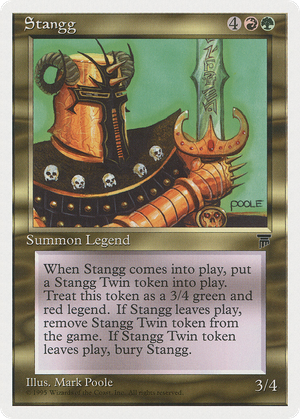
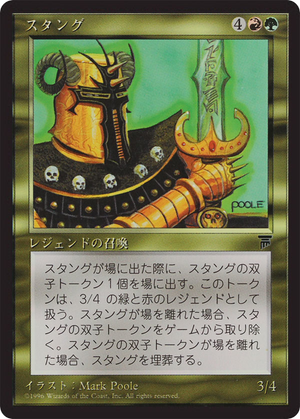
Stangg



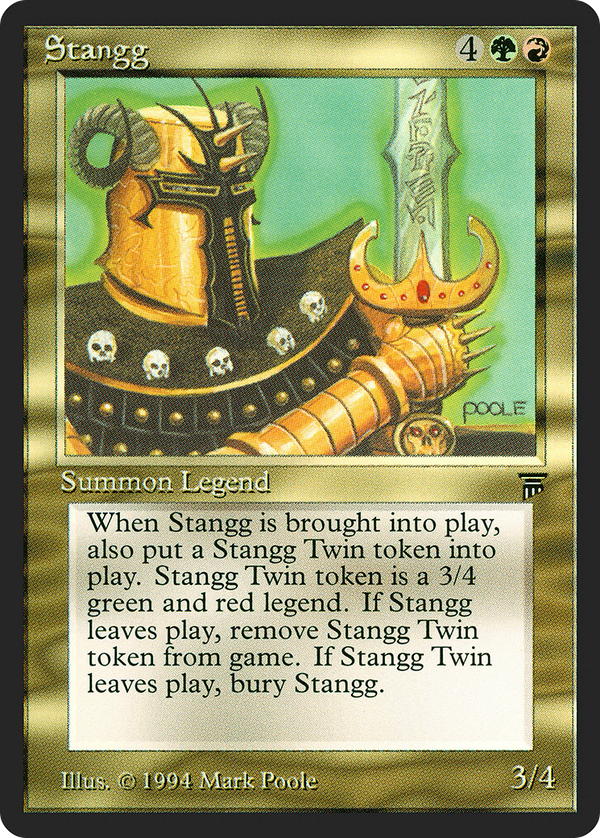
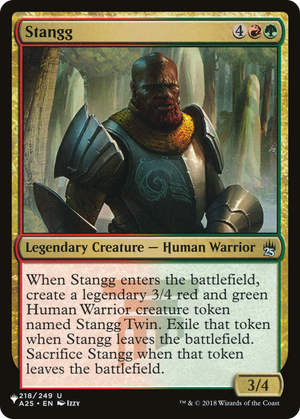
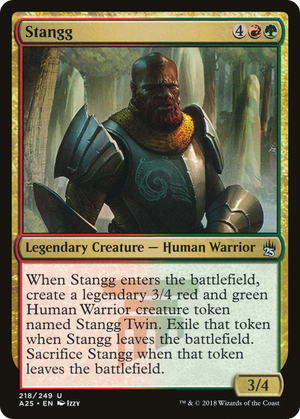
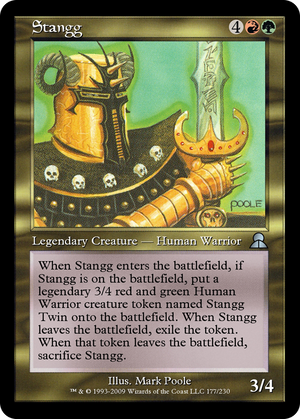
Twin-token legendaries are a design corner Wizards has revisited rarely and cautiously, and this is where the experiment began. The card is built as a self-contained mutual-destruction clause: the enters trigger doubles your battlefield presence into two 3/4 bodies, but the exit triggers chain so that losing either body loses both. That coupling is the entire point. The token, named Stangg Twin, is its own legendary creature rather than a copy that shares the original's name; the exile-on-leave clause removes the token from the game entirely, and the sacrifice clause means killing the token also kills the original. Read together, the three lines form a closed system: one creature's worth of vulnerability stretched across two creatures' worth of board presence. The descendants are easier to spot in hindsight than the ancestor was at the time. Brothers Yamazaki took the twin-legend idea and turned it into a tribal payoff; later "create a token copy of this" commanders inherited the doubled-body math without the suicide pact. What this early version really demonstrated is how fragile mutual-dependency clauses are to engineer cleanly, and why almost every twin-body legend printed since has loosened the leash.