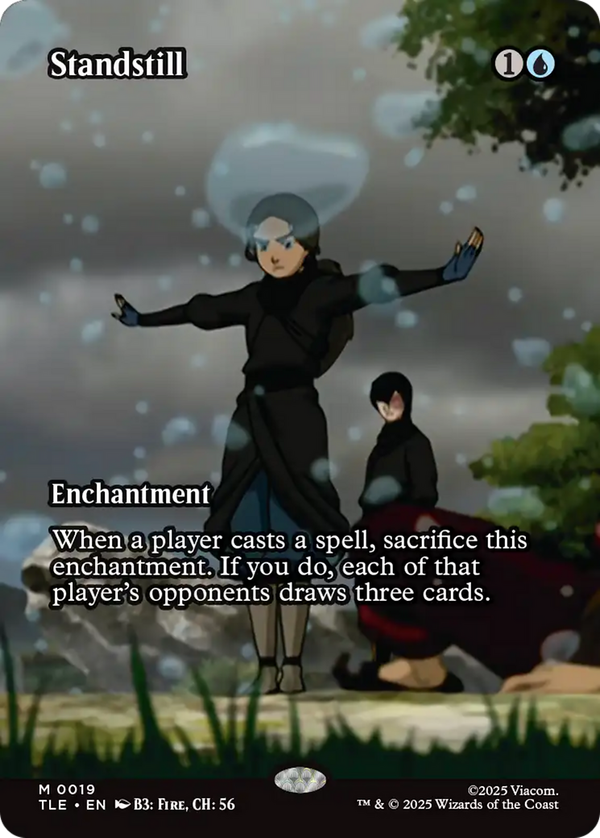
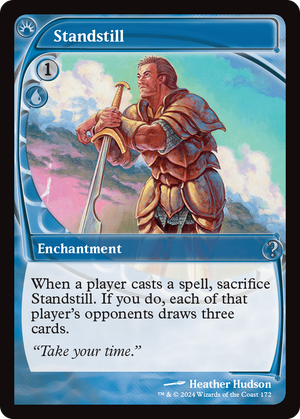
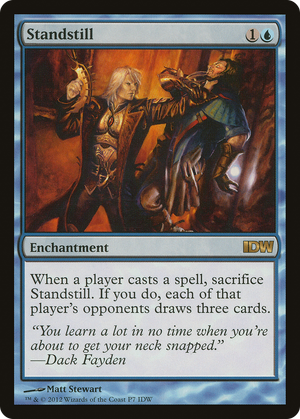
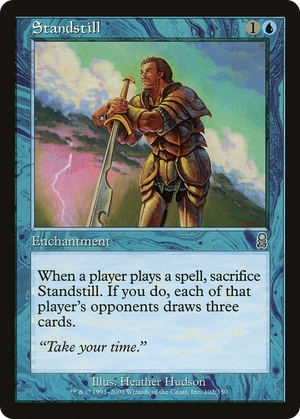
Standstill


A threat that resolves with no immediate effect, then sits on the battlefield daring both players to blink. The genius is in who pays for breaking the truce: whoever casts a spell hands their opponents three cards apiece, which means the deck that runs Standstill builds itself to need spells less than its opponent does. Land-heavy control and manlands answer the riddle: develop your board through permanents that aren't spells, manufacture pressure without ever triggering the enchantment, and force the opponent to crack it on their own terms. Faeries shells and old draw-go control weaponized exactly this, where a few creature-lands or a planeswalker grind out a clock while Standstill turns every removal spell, every counter, every tempo play into a confession that costs three cards. The card states card advantage as leverage rather than as raw acceleration: the value is contingent, deferred, and weaponized against the player least able to wait. The symmetry looks fair on the surface, but the design was built to be asymmetric in practice, rewarding the deck that has already decided it would rather do nothing. What separates Standstill from other enchantments that punish action is the steepness of the punishment and the totality of the patience it demands; the player who breaks first is almost always the one who could least afford to.