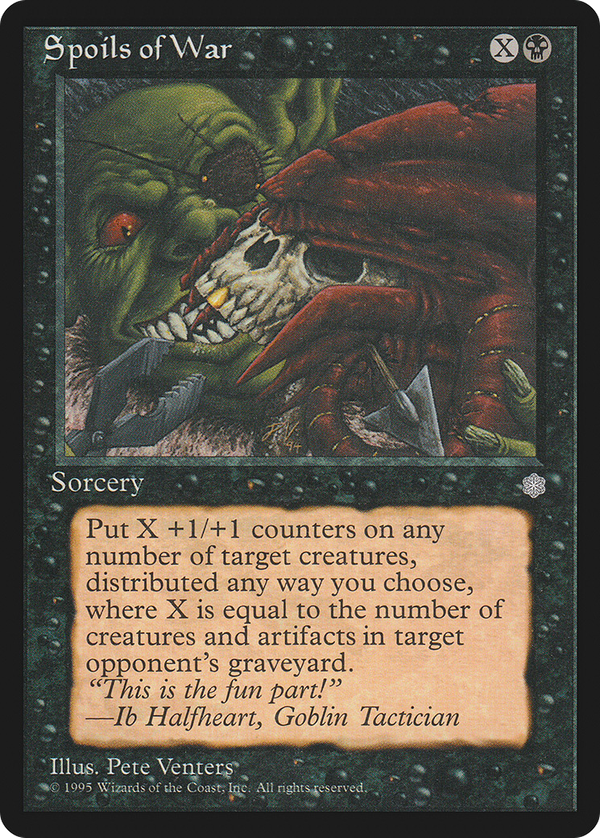
Spoils of War


A punisher's curse, scaled to the grave. The X here is doing two jobs at once: it sets how many counters you distribute, and because sits in the mana cost, it sets how much you pay for them. The count is opponent-defined, read off the artifact and creature cards in their graveyard as you cast. That makes this a strange piece of asymmetric design, since your ceiling lives in someone else's deck. Against an opponent who hasn't lost anything, X is zero and you pay a single to do nothing. Against a board that's survived a long attrition war (or a sacrifice-heavy shell that keeps feeding its own graveyard), the count climbs into the absurd, and you fund a corresponding pile of mana to cash it all in. That dual dependency is the discipline that kept it honest: you cannot reliably build toward a big Spoils of War the way you'd build toward an X spell that scales off your own lands or hand, because the fuel is manufactured by the game state, and the mana bill grows right alongside the payoff. As a sorcery, it asks you to pick your main-phase moment carefully: distributing counters across your creatures to break a board stall or push a lethal swing on a later turn. It is the kind of black design that treats an opponent's losses as your resource, dressed up here in a curiously growth-oriented coat of +1/+1 counters.