Spoils of Evil


A graveyard-reading ritual that pays out exactly as much as your opponent has done. The design conceit is parasitic in the literal sense: this spell has zero floor, producing nothing unless the opposing graveyard is already stocked with artifacts and creatures, and it scales linearly off an information source the caster does not control. That dependency is what dates the card to its era. Early design was fascinated by effects that turned an opponent's board, hand, or yard into a resource, and rituals that converted opposing material into colorless mana plus life were a recurring experiment. The trouble is the timing math. Casting it before your opponent has committed cards yields nothing, so the spell wants a late window, but a ritual that only fires late is a ritual that arrives after the mana would have mattered most. The life gain is incidental padding on top of a burst that is hard to aim and harder to bank, since instant-speed colorless mana with no spell waiting on it simply evaporates at end of step. What you are looking at is a snapshot of a moment when the game was still mapping the boundary between "punish the opponent's graveyard" and "do something you can actually plan around," and landing closer to the former.
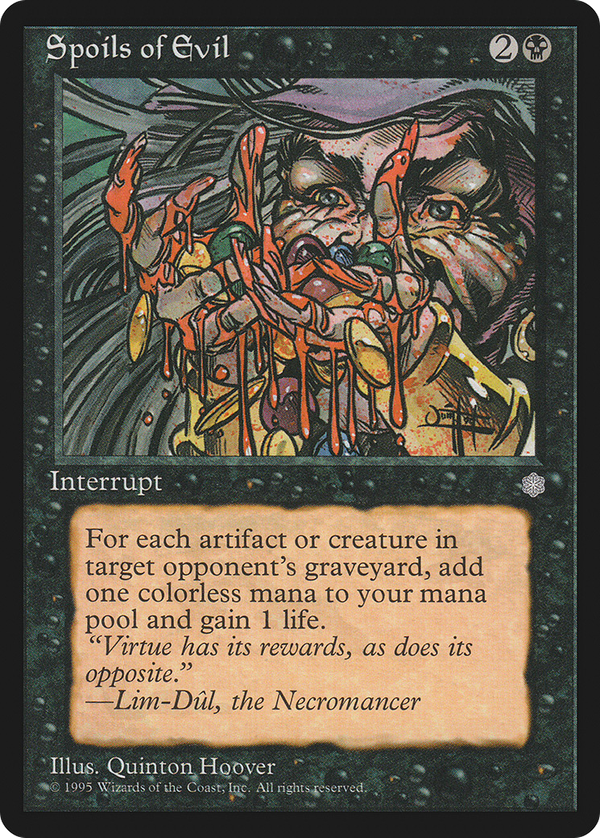
Rules text
 and you gain 1 life.