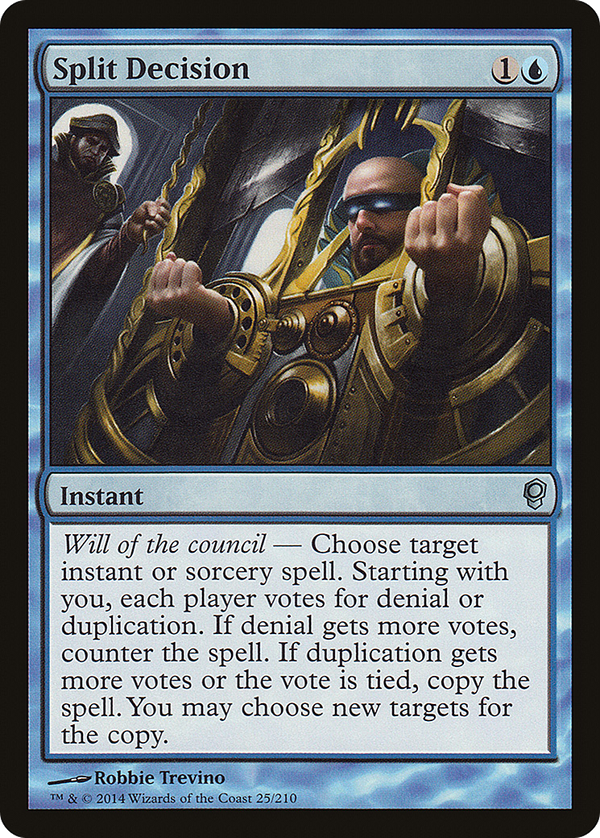
Split Decision


A vote turns counterspell math into a social problem. Most ways to interact with a spell on the stack are a private transaction between two players: you hold up the mana, you decide, the spell lives or dies. This one drags the entire table into the decision, and the outcomes are deliberately stacked so that doing nothing is never the result. Either the spell gets countered or it gets copied, with the copy under your control and redirectable to a new target, so the worst case for the original caster is rarely neutral. The tie-goes-to-duplication clause is the load-bearing rule. In a multiplayer game it means a single dissenting vote cannot deadlock the table into the harmless outcome, and it gives the politics real teeth, because copying a removal or burn spell onto a new target can be worse for the room than letting the original resolve. That asymmetry is what makes it a negotiation rather than a coin flip: you are not casting it to counter a spell, you are casting it to force a public count of who wants that spell dead and who would rather see it doubled. The same tie clause flattens the card in a duel. There, only two votes exist, yours and your opponent's, so a split is the likeliest result, and a split defaults to duplication; whenever your opponent disagrees with you, you get the copy. The negotiation collapses into a near-deterministic two-mana copy spell. It is built for a crowd; with no crowd, the vote evaporates.