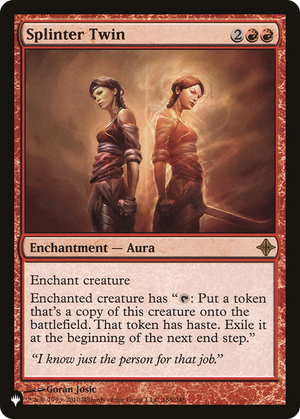
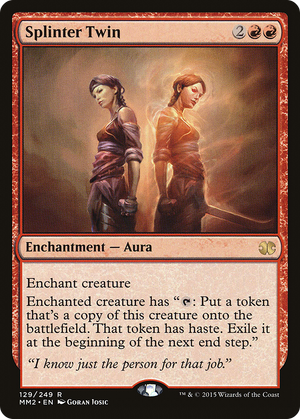
Splinter Twin


The whole engine is a two-step tap dance: the aura grants its host a tap ability that mints a hasty copy, and if that copy can untap the original on its way to the battlefield, then a single creature with a self-resetting untap turns the activation into an arbitrary loop. Tap to copy, the copy untaps the host, tap again, and the board fills with hasty attackers until the end-step clause exiles every token. Splinter Twin is dead on its own; it needs a partner whose ability resets its tap state for free. Deceiver Exarch and Pestermite both untap a target as they enter, so attaching the aura to one of them and then activating the granted ability produces an unbounded swarm of haste-bearing copies. Both halves read as reasonable cards to draw alone: an untapping body that stalls the ground or taps down a blocker, and an aura that only becomes lethal once it lands on a creature whose own ability resets the tap (on anything else it just mints one temporary token a turn). The combo's resilience came from deploying the creature half at instant speed (often on the opponent's end step) and saving the sorcery-speed aura for the kill turn. The exile clause is the leash: every token vanishes at end of turn, so the engine yields nothing permanent unless the alpha strike ends the game, which is exactly what it was built to do.
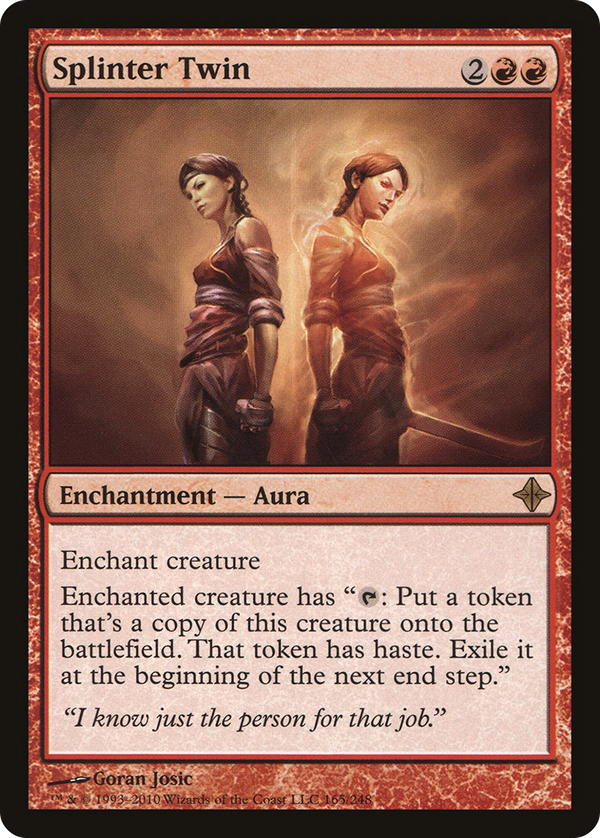
Rules text
 : Create a token that's a copy of this creature, except it has haste. Exile that token at the beginning of the next end step."